I co-discussed women's role in Yemen, last week, in a webinar organized by the Wilson Center.
Showing posts with label Feminist Arabs. Show all posts
Showing posts with label Feminist Arabs. Show all posts
Wednesday, April 7, 2021
Monday, July 30, 2018
Remembering One of Yemen's Pioneer Women, Raufa Hassan
April - 2018
I wrote for Daraj.com in Arabic about one of Yemen's most remarkable women, late dr. Raufa Hassan, on the seventh anniversary of her passing.

I wrote for Daraj.com in Arabic about one of Yemen's most remarkable women, late dr. Raufa Hassan, on the seventh anniversary of her passing.


Monday, April 18, 2016
Co-Speaking With Nawal El Saadawi

Sharing the stage with the legendary feminist writer like Dr. Nawal El Saadawi, later today is insane. Despite that ever since (and about) the Arab Spring, El Saadawi has been embracing ideas that I don’t agree on, speaking with her on Monday would be too good to be true. Can’t wait!
:: ~~|~~ :: where & when the talk will be: Today, Stockholm at Södra teatern at 7.00 pm, for more info see here.
Wednesday, October 30, 2013
I Read I Write, Yemeni Women Fight To Get Education
Boushnak explains I Read I write series of portraits:
Wednesday, September 11, 2013
Yemen: End Child Marriage
Yemen should protect its girls from the devastating effects of early marriage by setting 18 as the minimum age for marriage by law, Human Rights Watch said today. The current political transition and drafting process for a new constitution offers a unique opportunity for the Yemeni government to enact laws protecting the rights of girls. >>>>
Tuesday, April 30, 2013
Yemen youth take action
My first contribution piece to FreeArabs.com
*
Past generations of Yemenis have watched as their country descended the ladder of gender equality. Luckily, Yemen’s young activists are stepping up and speaking out.

*
Past generations of Yemenis have watched as their country descended the ladder of gender equality. Luckily, Yemen’s young activists are stepping up and speaking out.
 |
From left to right, Diala Haidar, FarahBarqawi and Yalda Jounes, the co-founders of TUWAW's Facebook page and international movement.
“The Uprising of Women in the Arab World” (TUWAW) Facebook page has accrued over 100,000 followers since its inception in October of 2011. The page invites users to follow trending activism issues and engage in international dialogue concerning topics relevant to Arab women.
While I know the page is regularly updated by posts from around the world, it shocked me to learn that the highest number of contributions came from Yemen – a country long accustomed to the murky bottom of the discrimination-ranking Gender Index. Considering how limited Internet access is in Yemen, the feat deserves extra plaudits. Apparently Yemen is pushing back against the gender inequalities that make it difficult for women’s success. Co-founders of TUWAW’s Facebook page and international movement, Yalda Jounes, Diala Haidar and Farah Barqawi, confirmed the incredible Yemeni response during a Women Bloggers Conference in Morocco last week. They noted that most of the posts come from a surprisingly wise pool of Yemeni youth. The posts by these youngsters adroitly reflect on the serious social grievances Yemeni women endure, including child marriage and sexual harassment.
This is what founders like Farah Barqawi hoped the page would encourage. “The idea of the page and blog,” she said, “came with the Arab Uprisings… with the awareness that women and men in the Arab World were missing rights and freedoms.” The page would, she and her co-conspirators believed, provide the perfect forum for women (and men) to lobby for bigger steps toward gender equality. While the uprisings were a good start, “revolutions,” Barqawi stated, “are either complete with women or [aren’t] at all.”
It’s this idea that’s caught on with TUWAW’s followers. Those posting from Yemen seem to have fully embraced the notion that a total liberation for a nation won't happen if half of its population is oppressed. The dissemination of this concept is particularly important in a country like Yemen, which is often characterized by its ultra-conservative mores. Luckily, we can see some changes taking shape there – changes I never imagined I’d see.

One instance occurred in March of 2013 when a women's rights activist, Renad Mohammed, managed to hang a massive, feminist, political poster in the heart of Sana’a city for a week. The poster showed women’s rights activist Ala'a al-Eryani holding the following statement: “I'm with the Uprising of Women in the Arab World because I won't stop demanding my rights.” It was an unprecedented step that brought women’s rights issues directly to the people.
Additionally, Mohammed organized and held a seminar on women's rights issues in Yemen, to mark International Women's Day. The idea, she admitted, was inspired by the TUWAW Facebook page. The seminar was a complete success and even attracted the attention of BBC Arabic, which reported on the event. Hopefully Yemen's law-makers were listening as well.
While TUWAW is getting the message out to youth activists around the Arab World, its themes seem to resonate particularly strongly with intrepid young activists in Yemen. What the Yemeni bloggers, Facebook users, and organizers are showing is that women’s rights and Yemeni activism are both alive and strong.
Thursday, March 7, 2013
دعوة من نساء اليمن للسلام في يوم المرأة العالمي

اليوم اليمن في امس الحاجة لتعزيز عملية بناء السلام بين كل أطيافه بعد ان ذقنا الأمرين من حروب ونزاعات على مر العشرين عام الماضية. غدا تُنظم مجموعة من نساء اليمن بقيادة الناشطة والباحثة سارة جمال، تنظم المجموعة وقفة رمزية نسوية تدعو الى السلام بمناسبة يوم المرأة العالمي. تقول سارة جمال: " نالت اليمن نصيبها من النزاعات المسلحة بين حرب 1994 و حروب صعدة الست و أرحب و الحصبة و أحداث سبتمبر 2011 و لم يتضرر قادة و تجار الحروب بل نحن من خسرنا أقواتنا و بيوتنا و أرواح من نحب، لذا هذه دعوة لنساء اليمن ان ينزلنّ معنا في الثامن من مارس أمام الجامع الكبير في قلب مدينتنا القديمة لنقول لليمنيين لن نرسل أبنائنا و أزواجنا و آباءنا للقتال، ونحن لها، نساء اليمن و سلامها!" (رابط الفعالية)
كفاية حروب ونزاعات .. يانساء اليمن اتحدن ضد الحروب والعنف! هذه فرصتنا لكي نثبت اننا جزء من سلام أرضنا. فالقضية لاتتعلق بالمرأة او الرجل فالمشكلة هي الإنسان. فلندع الصراعات والانقسامات على جنب ولنتعامل مع المستجدات بنظرة شمولية قوامها الإنسان بشقيه الرجل والمرأة.
غدا سيحتفل العالم بيوم المرأة العالمي وفي ذلك تنقسم الآراء مابين من هو مع و من هو ضد مطالب المساواة بين الجنسين في كافة مجالات الحياة. فهناك فئة تدعوا بإخلاص ودون ملل لنهوض بالنساء وتمكينهنّ حتى يصلنّ لمناصب القرار مثلهنّ مثل الرجال، وبالطبع لتحقيق ذلك يستلزم الخوض في عملية طويلة تتطلب معالجة عدد هائل من التحديات الاقتصادية والاجتماعية والثقافية والسياسية التي تواجه النساء بشكل خاص. وفي الكفة الأخرى الفئة التي تتعلل بأحكام دينية أو أسباب اجتماعية أو بيولوجية أو سياسية أو جميع ماذكر، تتعلل بتلك الأسباب لتبرر رفضها لمبدأ المساواة بين الجنسين. ربما الأمر أكثر تعقيدا من ذلك.
الأمر المثير للإهتمام
في مناصرة قضايا المرأة (أو مايعرف بالنسوية) هو أنه ليس بالضرورة ان المناصرين هنّ
من الإناث .. فليست كل امرأة هي نسوية وليست كل نسوية هي امرأة. هناك عدد من
الذكور المهتمين بقضايا المرأة بشكل متفاني وهناك نساء ترفضنّ مبدأ المساواة
والعكس صحيح. الأمر متشعب جداً ويدفع المرء الى البحث والتعمق فيه ودراسته لمحاولة
إدراك حيثيات هذه الحالة الاجتماعية.
 | |
| د.رؤوفة حسن |
بالعودة ليوم المرأة
العالمي ورمزيته في الحث على تحقيق المساواة بين الجنسين أتذكر كيف بدأت قصتي مع
البحث في مبدأ المساواة. اتذكر اثناء مراهقتي كنت اشاهد على تلفاز بيتنا في صنعاء الرائدة
الأكاديمية المرحومة د.رؤوفة حسن عندما كانت تُجرى معاها لقاءات بخصوص قضايا اجتماعية.
كانت تُشدد دائماً على "تعزيز مفاهيم المواطنة القائمة على الحقوق والواجبات
المتساوية وترسيخ مبدأ تكافؤ الفرص بين كل افراد المجتمع بغض النظر عن نوعهم
الاجتماعي..." وأمور شتى. كنت أقول في سري: "يالها من امرأة مذهلة ..
كانت تبهرني بمعرفتها الواسعة وطرحها الراقي جدا. وكنت أقراء في الصحف عن انجازات
المناضلة رضية شمشير أو عن ماما نجيبة حداد وعن الرائدة امة العليم السوسوه..
وعندما كبرت قليلاً وبدأت العمل كصحفية سنحت لي الفرصة لمقابلة عدد من تلك
الشخصيات اليمنية التي شكلت الحركة النسوية اليمنية في العصر الحديث أمثال المرحومة د. رؤوفة حسن التي
صاغت الكثير في نظرتي للأمور بشكل عام. والتقيت ايضا بالاستاذة أمل الباشا التي
اعتبرها اهم من عزز فهم النضال الحقوقي في وعيي.
 | |
| مع الأستاذة أمل الباشا |
في ظل المشاكل المتفاقمة التي تعيشها اليمن لربما
قد تكون المطالبة بالمساواة في غير محلها في الوقت الحالي. لكن ماذا عن تحقيق مبدأ
المواطنة الكاملة؟ ألم تُنادي ثورة اليمن في 2011 بالمواطنة الكاملة؟ نعم، نادينا
بذلك وبدولة مدنية تقوم على السلام والتسامح وقبول الآخر والمساواة في الحقوق
والواجبات لكل أفراده بغض النظر عن الفروق مهما كانت. ولكي نُحقق تلك المواطنة
الكاملة لابد من تحقيق المساواة في الحقوق بين الرجل والمرأة، وكم أحوجنا الى ذلك لأنه
حتي اليوم لم يُسن قانون السن الآمن للزواج في اليمن للحد من زواج الصغيرات الذي يؤدي
الى حدوث وفيات كثيرة لفتيات صغار السن زوجن باكراً فمنهن من ماتت أثناء الولادة
أو المعاشرة الجنسية، بالإضافة الى ذلك فانه حتى اليوم لا تملك المرأة اليمنية
حقها في عقد قرانها أو الشهادة في عقد غيرها.
هناك الكثير أمامنا لكي نفعله في ذلك الصدد ولابد
من مواصلة مسيرة تلك الرائدات المناضلات اليمنيات الاتي افنين عمرهنّ لتعزيز مبادئ
المواطنة الكاملة والدفاع عن حقوق المرأة اليمنية. وان كانت الدعوة لتحقيق
المساواة بين الجنسين في اليمن في غير أوانها فمتى سيكون ذلك؟
Sunday, December 16, 2012
A Bleak Future for Yemen’s Female Leaders
My op-ed for al-Akhbar news website about the current plight for female opinion leaders in Yemen, published in Dec. 10th, 2012.
*****

The participation of Yemeni women in the country’s uprising fascinated the world early last year. Yet the uprising also represented simultaneous opportunity and danger for women, especially female opinion leaders.
An opportunity because women had the chance to be empowered. For instance, their parliamentary participation quota is under consideration to be increased from 15 to 30 percent. A danger because of the risk looming over them and the high price they would have to pay for their audacious political stances.
Various factors shape the risks facing women. In a conservative and tribal society like Yemen, the idea of women in leadership roles has always been a problematic issue in the country’s contemporary history. For those women who dare to lead, they face virtual wars as they confront media slander and physical attacks from their opponents.
The women I’m referring to are the ones who carry the heavy burden of defending women’s rights. They were fortunate enough to enjoy a number of privileges and stick out in a country where nearly 67 percent of females suffer from illiteracy.
A number of fortunate women in Yemen have chosen to be active in advocating for human and women’s rights. Typical of a patriarchal society, these women are on the margins of the political stage, their real function is to provide a relatively stable participatory stage for influential figures to take part in decision-making. These women are not only deprived from decision-making power, but also face an increase in aggression for their political stances.
 One such woman is outspoken writer Bushra al-Maqtari, who has actively participated in protests and spoken against the atrocities committed during former president Saleh’s regime.
In January 2012, Maqtari wrote a piece that could’ve led to her death. She has graphically described in her writings the savagery that took place in her birthplace and current residence of Taiz province. In that piece, she boldly wondered why God has disappointed the people of Taiz when they were bombarded by gunshots during the ‘Life March,’ a 260-kilometer procession from Taiz to Sanaa on 20 December 2011.
The piece spread like wildfire, and not long ago, conservative Islamist groups headed by the Islah party defamed her and called for her murder. In Taiz’s Freedom Square, members of the party mobilized protesters to march to her home and kill her. Several women of Islah beat Maqtari when she visited the square afterwards.
During a televised interview in Septmeber 2011, the Islamist MP, Sheikh Mohammed al-Hazmi lashed out at Maqtari. He said that a fatwa calling for death would be issued against anyone who blasphemes, including Maqtari.
Maqtari doesn’t live in her house anymore; she has sought protection at her relatives’ homes. In August 2012, she filed a complaint with Yemen’s attorney general over the defamation campaigns waged against her in hopes of receiving an official consideration. Thankfully, she’s alright, but the danger still awaits.
 Atiaf Alwazir, a Yemeni-American researcher and activist, has been one of the faces of Yemen’s uprising. She is a citizen journalist disseminating the latest on Yemen’s political and humanitarian situations in the international media. She has raised pressing concerns about the impact of the CIA’s drone strikes against Yemeni civilians.
Just like many other female intellectuals, Alwazir was the target of an online propaganda campaign, led by a male journalist who opposed her political opinions. She was called a traitor and a western spy. Even for a woman respected by many, the attacks against her reputation caused harm.
Hostility against women’s rights advocates has a long history in Yemen. For instance, in 1974, a group of Islamists took over and shut down the Yemeni Women’s Association in Sanaa, which offered basic literary lessons, craftwork training, and radio broadcast training. The association remained closed until it was reopened in 1979 by the late activist Raufa Hassan who, back then, was accused of being westernized and subsequently harassed and threatened by Islamist groups.
And this is only a partial list.
The situation for male opinion leaders is hardly better than that of females. Several men have been targeted, such as Abdelaziz al-Saqqaf who was killed in a 1996 car “accident.” Journalist Abdulkarim Al-Khaiwani was imprisoned for several months in 2007 for his critical writings against the military. Journalist Abdelelah Shaye was one of the first journalists to report on the CIA’s civilian-killing drone strikes and accordingly, he has been behind bars since 2010. Journalist Nabeel Subaye openly criticized Ahmed Saleh, son of former president Saleh and commander of the Yemeni Republican Guard, and then faced an online propaganda campaign, attacks on his car and house, and death threats.
Again, the list goes on.
I specifically address the targeting of female opinion leaders because even though female activists played a major role during the revolution, many do not want to continue in these leading roles. The women facing harassment are independent thinkers, closer to the youth movement than traditional political parties. Their struggle is not only to fight marginalization, but also to fight the defamation and threats.
Another crucial reason for my focus on females is the potential for a domino effect. If one female leader is terrorized, then other emerging female leaders could become silent. It’s a distressing reality given the fact that there are no laws or big women’s rights organizations that can defend them. Lawlessness in Yemen harms everyone. However, we feminists can only survive by sticking up for each other and breaking the silence.
*****

The participation of Yemeni women in the country’s uprising fascinated the world early last year. Yet the uprising also represented simultaneous opportunity and danger for women, especially female opinion leaders.
An opportunity because women had the chance to be empowered. For instance, their parliamentary participation quota is under consideration to be increased from 15 to 30 percent. A danger because of the risk looming over them and the high price they would have to pay for their audacious political stances.
Various factors shape the risks facing women. In a conservative and tribal society like Yemen, the idea of women in leadership roles has always been a problematic issue in the country’s contemporary history. For those women who dare to lead, they face virtual wars as they confront media slander and physical attacks from their opponents.
The women I’m referring to are the ones who carry the heavy burden of defending women’s rights. They were fortunate enough to enjoy a number of privileges and stick out in a country where nearly 67 percent of females suffer from illiteracy.
A number of fortunate women in Yemen have chosen to be active in advocating for human and women’s rights. Typical of a patriarchal society, these women are on the margins of the political stage, their real function is to provide a relatively stable participatory stage for influential figures to take part in decision-making. These women are not only deprived from decision-making power, but also face an increase in aggression for their political stances.

In January 2012, Maqtari wrote a piece that could’ve led to her death. She has graphically described in her writings the savagery that took place in her birthplace and current residence of Taiz province. In that piece, she boldly wondered why God has disappointed the people of Taiz when they were bombarded by gunshots during the ‘Life March,’ a 260-kilometer procession from Taiz to Sanaa on 20 December 2011.
The piece spread like wildfire, and not long ago, conservative Islamist groups headed by the Islah party defamed her and called for her murder. In Taiz’s Freedom Square, members of the party mobilized protesters to march to her home and kill her. Several women of Islah beat Maqtari when she visited the square afterwards.
During a televised interview in Septmeber 2011, the Islamist MP, Sheikh Mohammed al-Hazmi lashed out at Maqtari. He said that a fatwa calling for death would be issued against anyone who blasphemes, including Maqtari.
Maqtari doesn’t live in her house anymore; she has sought protection at her relatives’ homes. In August 2012, she filed a complaint with Yemen’s attorney general over the defamation campaigns waged against her in hopes of receiving an official consideration. Thankfully, she’s alright, but the danger still awaits.

Just like many other female intellectuals, Alwazir was the target of an online propaganda campaign, led by a male journalist who opposed her political opinions. She was called a traitor and a western spy. Even for a woman respected by many, the attacks against her reputation caused harm.
Hostility against women’s rights advocates has a long history in Yemen. For instance, in 1974, a group of Islamists took over and shut down the Yemeni Women’s Association in Sanaa, which offered basic literary lessons, craftwork training, and radio broadcast training. The association remained closed until it was reopened in 1979 by the late activist Raufa Hassan who, back then, was accused of being westernized and subsequently harassed and threatened by Islamist groups.
And this is only a partial list.
The situation for male opinion leaders is hardly better than that of females. Several men have been targeted, such as Abdelaziz al-Saqqaf who was killed in a 1996 car “accident.” Journalist Abdulkarim Al-Khaiwani was imprisoned for several months in 2007 for his critical writings against the military. Journalist Abdelelah Shaye was one of the first journalists to report on the CIA’s civilian-killing drone strikes and accordingly, he has been behind bars since 2010. Journalist Nabeel Subaye openly criticized Ahmed Saleh, son of former president Saleh and commander of the Yemeni Republican Guard, and then faced an online propaganda campaign, attacks on his car and house, and death threats.
Again, the list goes on.
I specifically address the targeting of female opinion leaders because even though female activists played a major role during the revolution, many do not want to continue in these leading roles. The women facing harassment are independent thinkers, closer to the youth movement than traditional political parties. Their struggle is not only to fight marginalization, but also to fight the defamation and threats.
Another crucial reason for my focus on females is the potential for a domino effect. If one female leader is terrorized, then other emerging female leaders could become silent. It’s a distressing reality given the fact that there are no laws or big women’s rights organizations that can defend them. Lawlessness in Yemen harms everyone. However, we feminists can only survive by sticking up for each other and breaking the silence.
Wednesday, October 10, 2012
Why Hana and I Support the Uprising of Women in the Arab World?
As the world is astonished with the recent e-movement calling for equality for women in the Arab world, Hana al-Khamri and I contributed to The uprising of women in the Arab world انتفاضة المرأة في العالم العربي with this poster and it goes like this:
Hana'a and Afrah from Yemen/ Sweden
Hana'a:
Because when I try to behave as a human being, I'm accused of imitating men.
Afrah:
Because the time has come to reject the patriarchal system imposed on both genders.

Hana'a and Afrah from Yemen/ Sweden
Hana'a:
Because when I try to behave as a human being, I'm accused of imitating men.
Afrah:
Because the time has come to reject the patriarchal system imposed on both genders.

Tuesday, October 9, 2012
Extraordinary Contribution from Yemen to the #ArabWomenUprising
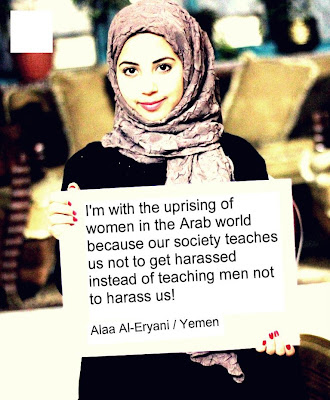
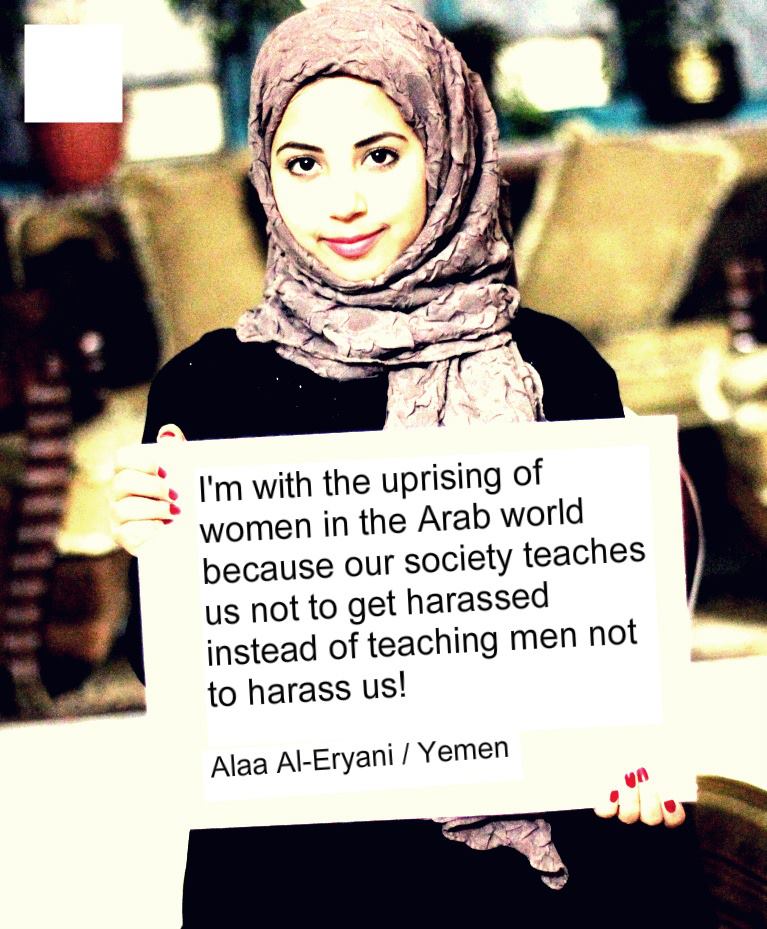
The young Alaa contributed to The uprising of women in the Arab world انتفاضة المرأة في العالم العربي facebook page with this poster that tells a lot about sexual harassment in Yemen. With Alaa and other ladies in Yemen, the struggle continues till girls have safe streets and status.
Thursday, August 30, 2012
Is There a Law to Prohibit Sexual Harassment in Yemen?
I was only 9 years old when I had my first experience with sexual harassment. That experience is not only still vivid in my memory, but also it was the beginning of my saga with being sexually harassed - just like millions of females in Yemen and around the world.
Of course, I never used the "alleged" law presented below; simply because the judicial system in Yemen is extremely corrupt.
I'm posting this important piece the Yemen Times just published about matters related to laws prohibiting sexual harassment in Yemen. Worth-reading!
***************
POLICE: SEXUAL HARASSMENT LAW NEEDS RE-WORDING
 An illustration by Safe Street Campaign in Yemen
Women in Yemen are exposed to multifaceted kinds of violence, including sexual harassment that renders them unable to exercise their rights in both personal and professional environments.
Activists say there are certain loopholes in Yemen’s laws regarding punishments for crimes. Such loopholes contribute to the spread of the harassment phenomenon seen in the Yemeni community. A reported ninety percent of women are subject to different kinds of harassment, according to information released by the First Regional Arab Conference on harassment against women held in 1999 in Cairo.
“Yemeni law stipulates that anyone who commits an offending act in public is sentenced to no more than six months imprisonment, or he is to be fined,” Yahiya Al-Sakhi, a lawyer, said.
Al-Sakhi said that for anyone forcing a female to behave immorally, the punishment is no more than one year in prison, in addition to a fine. “If the woman consents to practice immorality, the two are sentenced to no more than six months in jail in addition to a worthless fine, 1,000 riyals.”
He said the loophole pertinent to the harassment article is a condition that notes there must be a witness to the harassment in order for there to be a punishment. Al-Sakhi said the law items are out of date, particularly nowadays.
“We need to modernize the law in order to go along with the current time,” he said. “The last law amendment was in 1994. Thus, I think the fine should be raised to 100,000 riyals as an effective deterrent.”

Abdulghani Al-Wajeeh, the Walking Police commander, spoke of the loopholes that hinder them from mitigating the spread of harassment.“One of the problems we face is the difficulty of capturing the culprit in front of witnesses,” Al-Wajeeh said. “This is an obstacle; a woman could be subject to harassment in some places unseen by others, which doubles the spread of this phenomenon.”
The long police procedures and the inadequacy of witnesses hinder authorities from implementing immediate punishment, and this could help the culprit escape the offence, Al-Wajeeh said.
He said it is essential to re-word the law to include strict procedures because the 1,000 riyals fine doesn’t deter anyone and the risk of six-month imprisonment isn’t taken seriously.
The security situation in the country, he said, makes it difficult to combat this phenomenon. He said family, schools, civil society organizations and mosques have to play a role in ending harassment instead of concentrating on politics.
Although the law is still waiting for discussion in the parliament drawers, the police have visions and strategies to implement the meaning of community police so that society takes part and oversees, said Al-Wajeeh. “However, these visions and strategies have not been in effect on the ground.”
Ghaida Al-Absi, a social activist, said there are 11,000 organizations, but the organizations that aim to tackle harassment against women are very few. “The organizations always work to please to the patrons, not to solve societal problems,” she said. “The problem is not limited to law; it is to its implementation as well.” Al-Absi said we need safe streets (read more) and the cooperation of all to curb sexual harassment offenses toward women.
 Ghaida Al-Absi is leading a campaign calling for safe streets without sexual harassment for all in Yemen
Of course, I never used the "alleged" law presented below; simply because the judicial system in Yemen is extremely corrupt.
I'm posting this important piece the Yemen Times just published about matters related to laws prohibiting sexual harassment in Yemen. Worth-reading!
***************
POLICE: SEXUAL HARASSMENT LAW NEEDS RE-WORDING

Women in Yemen are exposed to multifaceted kinds of violence, including sexual harassment that renders them unable to exercise their rights in both personal and professional environments.
Activists say there are certain loopholes in Yemen’s laws regarding punishments for crimes. Such loopholes contribute to the spread of the harassment phenomenon seen in the Yemeni community. A reported ninety percent of women are subject to different kinds of harassment, according to information released by the First Regional Arab Conference on harassment against women held in 1999 in Cairo.
“Yemeni law stipulates that anyone who commits an offending act in public is sentenced to no more than six months imprisonment, or he is to be fined,” Yahiya Al-Sakhi, a lawyer, said.
Al-Sakhi said that for anyone forcing a female to behave immorally, the punishment is no more than one year in prison, in addition to a fine. “If the woman consents to practice immorality, the two are sentenced to no more than six months in jail in addition to a worthless fine, 1,000 riyals.”
He said the loophole pertinent to the harassment article is a condition that notes there must be a witness to the harassment in order for there to be a punishment. Al-Sakhi said the law items are out of date, particularly nowadays.
“We need to modernize the law in order to go along with the current time,” he said. “The last law amendment was in 1994. Thus, I think the fine should be raised to 100,000 riyals as an effective deterrent.”

Abdulghani Al-Wajeeh, the Walking Police commander, spoke of the loopholes that hinder them from mitigating the spread of harassment.“One of the problems we face is the difficulty of capturing the culprit in front of witnesses,” Al-Wajeeh said. “This is an obstacle; a woman could be subject to harassment in some places unseen by others, which doubles the spread of this phenomenon.”
The long police procedures and the inadequacy of witnesses hinder authorities from implementing immediate punishment, and this could help the culprit escape the offence, Al-Wajeeh said.
He said it is essential to re-word the law to include strict procedures because the 1,000 riyals fine doesn’t deter anyone and the risk of six-month imprisonment isn’t taken seriously.
The security situation in the country, he said, makes it difficult to combat this phenomenon. He said family, schools, civil society organizations and mosques have to play a role in ending harassment instead of concentrating on politics.
Although the law is still waiting for discussion in the parliament drawers, the police have visions and strategies to implement the meaning of community police so that society takes part and oversees, said Al-Wajeeh. “However, these visions and strategies have not been in effect on the ground.”
Ghaida Al-Absi, a social activist, said there are 11,000 organizations, but the organizations that aim to tackle harassment against women are very few. “The organizations always work to please to the patrons, not to solve societal problems,” she said. “The problem is not limited to law; it is to its implementation as well.” Al-Absi said we need safe streets (read more) and the cooperation of all to curb sexual harassment offenses toward women.

Wednesday, August 29, 2012
Dr. Elham Manea: A Fearless Yemeni Writer

Since I ever got to read one of her articles and I always feel so happy when she publishes a new piece. I carefully read her pieces because she mostly writes about the Taboo topics in the Arab World; "Sex, Religion, and Politics" - I'd add a very important taboo topic that's "Women's Rights" in the muslim Arab countries which she mainly focuses on. Based in Switzerland, Dr.Elham Manea is a fearless Yemeni writer who passionately examines the violations against our- women's- rights within her fantastic writings.
One of my most favorite topics she wrote about was about Hijab (head scarfs for muslim women). Her piece was titled, "Take Off Your Hijab" - you can read it here. That piece is just a slice of a series of bold pieces she already has wrtten. Unfortuantely, I have not read one of her many published books YET. That would be in my reading-book-list, definitely.
The reason I'm blogging about her is that, thanks to google-translate, I just read her piece about her thoughts of what shaped her life and career. I found it very interesting. I was very happy to know as well that she is going to speak at TEDxBern in Switzerland coming September and I really can't wait to e-watch her speech. I truly admire her and all her works, and I'm sure she'll be amazing in her speech.
Dr. Manea was kind enough to send me the original piece (read below) that she wrote in English for Mag20. If you'd like to read more of Dr. Mana's pieces, you can follow her blog here.
***********
Human Rights Are Universal Without a‘But’

What makes a person? What drives him or her to be the person he/she became known for? Sometimes I wonder; would I have been the same, if it was not for the eyes of my mother? The silent echoes of her eyes have hunted me all my life. If it was not for those echoes, I would not have written صدى الأنين (Echoes of Pain)- my first Arabic novel.
Would I have been someone different, if it was not for the voice of my father? Just like my mother, he talked long with me, about life, death, religion and the freedom of the human’s will. His idea of playing with me as a child was to recite a part of poem, and I have to start a new one with the last letter of his part. I loved his games. He was the philosopher that believed in me, more than I did. Dream of the stars, work hard, and with a bit of luck you will capture them in your hands. I never understood what he saw in me, but I learned overtime to trust his faith in me.
My mother’s stories were different though. Hers were formed by pain: pain of being a girl, circumcised at eight; pain by being cursed by her beauty, and therefore married off by her father at the age of 13 – better to marry her early and make her the trust of another man; and pain by the stories of women she knew – painful stories - a pain that was often interrelated to man. Man was not to be trusted. Man inflicts only pain. But then I had a man as a father! And God he was wonderful to me. He was my hero.
Over the time I learned how to make a story complete by looking at the different aspects of it. To hear my mother’s stories, would not be complete without hearing the voices of my father and all the men involved. Over the time I started to recognize the pain caused by injustice and discrimination but situate them within the social context that causes them. To change that social context means to change culture. And religion is part of that culture. It has to be reformed. Over the time I started to understand as well that to end injustice and discrimination, one has to fight for these ideals. Nothing comes for free. Rights have to be earned.
Traveling constantly between different Arab, Islamic and Western societies because of my father’s work as a diplomat made me the person I am as well. It does not really matter where you come from, your colour, religion, or gender, in the end you are a human. Everywhere I went I met humans. And everywhere I went I saw and heard of stories of discrimination. Discrimination is universal and so are the human rights that should be protected to end these violations.
Is it too much to ask? To insist that human rights are universal? Is it too much to persist in the belief that no one, no society, no state, no culture and no religion can use ‘a relativist’ argument to get away with violations of human rights? Human rights are universal. It is as simple as that. Many Arab States, conservative and Islamist groups, in addition to Western cultural relativists, claim that a woman should be deprived of her individual freedom and right to choice because her religion and culture dictates so! Their argument does not only reflect on women’s lives. It does also have consequences for the minorities living in these societies and for those who fight for the freedoms of religion, speech and political rights. I believe their argument is wrong and I am taking a clear stance against it.
Taking a clear stance against violations of human rights requires action - mine almost always has involved words- writing has been my way of breaking the wall of silence. I can breathe through the words.

Why should I invent a fiction, when reality surpasses any fiction in its brutality and absurdity? Writing in a literary fashion is one way to hold a mirror and reflect the social diseases and hypocrisy that plague my societies. I am gathering material for a third novel, but time has not been kind to me.
I made my name though through the opinion articles I have been writing since 2005. Thanks to the internet i was able to write about issues and ideas that were until then forbidden and censored in Arab media. Through this window it was possible to discuss issues of reformation of Islam and the human nature of Quran, human rights (which include women’s rights), citizenship rights (minority rights and equality before the law) and democratic reform. These articles have been published by different Arab websites and online magazines. Despite the hate messages I have been receiving, overtime, with persistence and stubbornness, I seem to have gained a reluctant acknowledgment that I do actually believe in what I say.
As a researcher, on the other hand, I try to investigate reality scientifically to learn the roots of our problems and how best to change and reform. I am a political scientist, but I have little respect to grand theories, when they neglect the very reality they try to explain. I prefer to look at the context of the phenomenon under investigation and from there draw the patterns that can explain it. It was this approach that I used when I tried to research the political dimension of women’s rights or more accurately the lack thereof in Arab societies. The result was published in a book by Routledge in London in 2011 entitled The Arab State and Women’s Rights: The trap of authoritarian governance. Building on this project, I am trying now to launch a research project that investigates legal pluralism in different context, especially in European societies, where the presence of Muslim migrant communities has led a country like Britain to introduce Islamic law in its legal system. I would like to research the consequences of introducing Islamic family laws in a European context.
This is the sum of what I am doing now: to write hoping that this, together with the work and efforts of the many reformers in the region will have some impact on the long term. I have always said I will stop writing when I give up hope in our ability to change and reform. So far, I have not stopped writing. Hope is still alive despite the disappointments, and these are plenty!
***********
Dr.Elham Manea will be one of the speakers at the first TEDxBern, on the 5th of September 2012.
Sunday, August 19, 2012
Yemeni Photographer Boushra Almutawakel Challenging the Norm

*********
BOUSHRA ALMUTAWAKEL, a Yemeni photographer, aims to provoke discussions about social norms and question the ways people and cultures judge one another. Her stylised portraits, mostly of Middle Eastern women, challenge the view held by many in the West that the veil is a symbol of oppression. Issues of identity are central to her work. Though she is skeptical of veils that completely obscure the individual, she draws similarities with the way some women hide behind heavy make-up: in both cases, a woman is concealed behind a social mask of sorts, often for her own comfort. Ms Almutawakel is openly critical of certain social expectations of women in Yemen, yet she wears a long black abaya in public because she "wouldn't feel comfortable otherwise". This ambivalence pervades her work.

Having studied in America, Ms Almutawakel has returned to live and work in Sanaa in Yemen. Her photographs—controversial among Yemenis—seem designed mainly for a Western audience. But some can now be seen in a show of regional artwork at the National Museum of Yemen in Sanaa.
Ms Almutawakel recently met with The Economist to discuss her photography, her views on women and the role artists play in revolutionary Yemen.
Tell us about the art scene in Yemen.
When I started in the 1990s I was supposedly the first female photographer. There were only a few artists throughout Yemen and we formed a network to hold exhibitions. Now there are many more because digital cameras have made photography more accessible and schools and universities teach design. But the scene is still limited and goes up and down with the economic and political situation. We need support to have our work exhibited locally and internationally.
Your latest project is a series of photographs of women dressed in traditional clothing worn by men. Can you explain?

I realised, to my great surprise, that men's traditional clothing is very similar to women's clothing—long, loose, modest and often with a head-covering. The focus in Western media is always on the way women are dressed so I wanted to challenge this idea. The work also shows that women are strong and, when given the opportunity, they can do what men can do. I also like the idea of feminising things. I am sure the world wouldn't be in the mess it is in if there were more of women's qualities, such as nurturing, in the world.
Much of your work focuses on women's veiling. Why is that?
It’s more controversial in the West, where the hijab and veil have become symbols. Veiling is part of the culture here, mixed in with religion. I think it's what women are used to wearing—and I don't feel comfortable without it in many places in Yemen. This is a highly segregated society in which men don't have much interaction with women, though that is changing in the cities. It is advantageous and empowering in some ways as it protects and privatises the woman's body.
You seem to be criticising and defending veiling at the same time.
A lot of people think that covered women are oppressed, backwards and uneducated. That is far from the truth. But at the same time I can't hear very well if I am veiled and I can't see the lips of women wearing the niqab. The biggest problem I have is with children being covered—there is nothing Islamic about that. I prefer our traditional veils which are colourful and more open. The black we've imported from the Gulf and the Wahhabis—with gloves and the rest of it—is too much. But women do have the choice.
Is there a real choice though?
Well, you have to have an open family to not cover because they, the culture and religion are such imposing forces. I had family members who wanted to wear the hijab [rather than the niqab] and it became a huge issue. It's perhaps the equivalent of you walking naked in the West! But I also disagree with France saying a woman can't wear a burqa or a hijab in school; that seems a violation of human rights.
Your work isn’t solely about the veil though, is it?
No. I have done a lot of work for international organisations. I have travelled all around the country to beautiful, remote areas where you wonder how people ever got there. Now it is harder to travel with the security situation. Of all my work, my favourite series might be Fulla, the Islamic Barbie doll.

Tell us more about that.
I thought it was wonderful to have something representative of our culture. Rather than having blue-eyed, blonde Barbie, this is a celebration of diversity. I thought it was interesting to tell women's stories through the doll because it is more acceptable. So I took a series of photographs showing her going to university, spying a young man she liked and going on trips. It's a fun series.
Were you trying to push boundaries again?
Yeah, but it is stuff that happens. Girls in university have all had crushes. There is so much that goes on that doesn't get discussed.
What has been the reaction to your work in Yemen?
Yemeni men didn't take too well to my "What if" series, in which the man becomes covered and the woman uncovered over the course of the series. A few women questioned it too, but I was shocked at how many went out of their way to tell me they liked it. They said the men should see what it’s like to be covered up!
We have seen a lot of artwork in response to the revolutions in the Arab world. Did the unrest here last year inspire creativity too?
The wonderful emerging talent was made clear during the revolution. It inspired a lot of the younger generation to design things, take photographs and post work online. I have to say, it didn't inspire me at all. I was worried for my children and our safety and I can't work without peace of mind. I went with some journalists and photographers to photograph the protesters, but it really wasn't my thing. Everyone was asking us to take pictures of the dead and I found that offensive. Hopefully this year will be a better work year for me.
Subscribe to:
Posts (Atom)