Showing posts with label Yemen. Show all posts
Showing posts with label Yemen. Show all posts
Monday, June 15, 2026
Monday, January 26, 2026
Yemen in 2026: Rivalries and Ruptures

ICDI - After more than a decade of war, Yemen stands as an example of a profound failure of strategy and reason by domestic leadership, regional intervention, and international diplomacy. In 2025, Yemen’s war became increasingly entangled with broader Middle East geopolitical recalibrations — especially around Red Sea security and changing Gulf relations — which have posed major challenges for diplomacy.
The end of 2025 marked a decisive rupture in the partnership in Yemen between Saudi Arabia and the United Arab Emirates (UAE), as years of concealed rivalry gave way to open political and military confrontation. Yemen’s conflict pits the Iran-backed Houthi armed group, which controls much of the north after toppling the internationally recognized government, against a fractured, Saudi-supported internationally recognized government located in the south, with both sides fighting for control over the Yemeni state. Complicating this divide, the UAE has long backed the separatist Southern Transitional Council (STC), seeking autonomy or independence for southern Yemen. Saudi Arabia’s direct intervention against the UAE-backed STC in eastern Yemen last December signaled a broader escalation, with Riyadh now actively moving to curb and roll back Emirati influence across the Red Sea and the Horn of Africa. Saudi Arabia now views Abu Dhabi’s proxy-based expansion as a direct threat to its strategic security belt. In parallel, Saudi Arabia has moved to reclaim stewardship over the southern issue, shifting it from an Emirati-managed proxy arena to a Saudi-supervised political track centered on dialogue by Riyadh convening southern leaders. This breakdown of relations between Riyadh and Abu Dhabi is almost certainly going to be a defining factor shaping Yemen’s conflict dynamics in 2026.
Three factors that could shape the conflict in 2026
It is difficult to predict with confidence what Yemen’s trajectory will be in 2026. Still, a few dynamics are likely to weigh more heavily than others: a conflict that remains stuck in a stalemate and fragmentation, deeper regional entanglements, and the humanitarian fallout of both. There is little indication that the war will move beyond this impasse. If anything, division itself now seems to function as the organizing principle of Yemen’s political landscape. With the Houthis firmly entrenched in the north and the anti-Houthi camp increasingly fractured across the south and east, it is hard to see what incentives exist for compromise rather than continued entrenchment.
The second uncertainty lies in regional geopolitics. With Red Sea security concerns, intensifying Gulf rivalries, and the possibility of a United States military strike on Iran, all converging, Yemen risks being treated as a secondary arena in wider strategic contests. Saudi Arabia’s pursuit of de-escalation in Yemen usually fails to translate into diplomatic engagement. At the same time, the proxy forces that the UAE has built in the south will not simply dissolve overnight. In this context, the Houthis may seek to exploit the situation by launching military offensives in areas they aim to expand. Whether they can do so, however, remains an open question, hinging largely on the level of support they continue to receive from Iran — and on Iran’s own fate should a US military confrontation materialize.
The final—and most unsettling—question is how long Yemen’s humanitarian catastrophe can continue to sit on the political sidelines. More than half of the population, an estimated 19.5 million people, now depend on humanitarian assistance, including 4.8 million internally displaced persons and over 61,000 refugees and asylum seekers. Yet even at this scale, the crisis no longer provokes urgency among donors, international institutions, or regional mediators. Aid is increasingly constrained and politicized through funding cuts, obstruction of aid, Houthis’ detentions of civil society and UN agency workers, donor conditionality, and access restrictions, while economic collapse and institutional decay deepen in the background. Ordinary Yemenis pay the price, day after day. And yet, history shows that desperation is rarely passive. One day, the pressure it creates may spill over in ways that no strategy, no negotiation, can contain.
Possible scenarios
These three dynamics create a context in which a range of outcomes is possible. How the conflict unfolds will depend on a number of moving parts: whether the Saudi-UAE rivalry escalates or stabilizes, whether the Houthis decide to push into new territory, and whether the international community steps in—or stays on the sidelines. Seen in this light, Yemen’s path over the coming year could follow two very different directions.
Scenario one: fragmentation vs stabilization
In the most optimistic scenario, Saudi Arabia manages to reassert itself as the dominant external broker in Yemen, reining in rival armed actors and nudging the fractured Presidential Leadership Council (PLC) toward at least a semblance of cohesion—a trajectory Riyadh has already begun to signal through its recent announcement of large-scale financial support for Yemen’s security and development sectors, particularly in southern areas previously dominated by UAE-backed forces.
A reduction in Emirati interference — whether due to shifting priorities or external pressure — would ease southern tensions and allow the council to exercise authority over its previously independent military units. In this scenario, the PLC would not suddenly transform into a fully functioning government, but it could begin to regain credibility, present a united front in negotiations with the Houthis, and establish clearer chains of command that make governance possible rather than purely reactive.
Yet even here, the gains would be fragile. Any stabilization would depend on Riyadh’s continued engagement, the council members’ willingness to subordinate personal ambitions, and the ability to balance external influence without appearing to cede sovereignty. Also, it depends on confronting Israel’s increasing entanglement in Gulf rivalries, aligning quietly with the UAE, and expanding its presence in the Red Sea and Horn of Africa — developments that Riyadh views as a strategic threat and factor in regional competition.
If all goes well, for the first time in years, Yemen could move from a state of pure paralysis to one where decisions are made, priorities set, and the country is at least minimally steered rather than drifting. It would not be a solution to Yemen’s deeper fractures, but a conditional stabilization that offers a space for peace talks.
Scenario two: entrenched fragmentation
The more likely — and more dangerous — scenario is one in which Saudi Arabia cannot fully assert control over southern armed groups, while the UAE quietly backs separatist and local forces in the south and east – a dynamic that risks escalating local violence and undermining the PLC’s authority — a pattern already evident in the large, recurrent pro-STC protests in Aden, which signal persistent popular legitimacy for the separatists despite Saudi-backed military gains.
In this trajectory, competition over territory, resources, and external patronage will intensify, particularly in regions such as Hadramout, where long-standing grievances are increasingly framed in autonomist or separatist terms. Fragmentation will become self-reinforcing, as armed groups resist any political settlement that threatens their economic lifelines or local dominance. National peace talks will likely stall, not only because of the Houthis, but because no unified counterpart exists on the other side. Frustrated by Saudi Arabia’s recent moves, the Houthis could respond with a military push toward areas they intend to advance into, framing Riyadh — not the UAE — as Yemen’s chief adversary. Houthi official, Mohammed al-Bukhaiti, has already accused Saudi Arabia of steering the war for its own strategic and territorial gain, manipulating regional actors, and placing its interests above Yemeni unity. While Houthis remain wary of the UAE and its ties to Israel, the Houthis portray Saudi actions as the greater threat — tools of a broader agenda serving American and Israeli ambitions under the veneer of religion.
In this context, Yemen drifts further toward a Libya- or Somalia-style model: a formally recognized government with shrinking authority, multiple competing power centers, and a conflict that no longer moves toward resolution.
Ultimately, 2026 is unlikely to be a year of resolution for Yemen. The question is not whether the war will end, but whether it will continue to be managed through fragmentation, external bargaining, and humanitarian containment. As regional actors recalibrate their priorities and Yemeni institutions remain hollowed out, Yemen risks slipping further into a conflict that no one is actively trying to win — or end. What happens next will depend less on new peace initiatives than on whether those with power, inside and outside Yemen, are willing to accept the costs of continued division as the status quo.
*This article was first written for and published on ICDI's website on 26 January. Original link is here.

Monday, January 19, 2026
Women and Peacebuilding in Yemen
 |
* * * * * * * *
Afrah supports the advancement of women and peacebuilding in Yemen, championing women’s leadership in inclusive peace processes through her Australia Assists deployment.
Growing Up in Sana’a
Growing up in Sana’a, the capital city of Yemen, Afrah became deeply aware of the challenges women faced in her community. As a young child, she had already witnessed the everyday realities of gender-based discrimination.
As a young girl, Afrah witnessed her mother dedicate 5 years of her life to secure a divorce in a system where Yemen’s Personal Status Laws allows men to end a marriage alone, but forces women to seek judicial approval.
‘I gained a deeper understanding of the gender disparities embedded in Yemen’s Personal Status Laws,’ recalled Afrah. ‘My mother’s struggle to secure a divorce illustrated the challenges many Yemeni women encounter in accessing justice.’
This life-changing experience and the realities she faced of gender discrimination sparked her lifelong passion for equality and justice. This passion was further ignited during the Arab Spring and has now led to supporting the United Nations Office of the Special Adviser to the UN Secretary-General on Yemen (OSEGY) deployed through Australia Assists.
From Blogging to Advocacy
In the heat of the Arab Spring, Afrah started sharing her thoughts through her personal blog. As thousands of Yemeni people took to the streets to demand a better Yemen, Afrah’s words found an online audience that resonated within Yemen and across the Middle East. This sparked the moment when her writing became a powerful platform for Yemeni advocacy, where she helped shine a light on the resilience and struggles of Yemeni women.
‘I recognised the responsibility of being an emerging voice for Yemeni women on a global stage,’ said Afrah. ‘It was a unique opportunity that shed light on their resilience, struggles, and contributions… it also deepened my commitment to advocating for gender equality and women’s rights in Yemen.’
After more than a decade of conflict, Yemen remains in a multi-faceted humanitarian crisis, with nearly 20 million people (roughly 60% of the population) requiring urgent humanitarian assistance this year alone. Women and girls are facing the brunt of it. ‘This dire situation is exacerbated by prolonged conflict, economic collapse, and climate-induced disasters… while access to essential services, such as healthcare, education and clean water remains severely limited,’ noted Afrah.
Afrah’s Life Mission
For Afrah, her work is her “life mission”, reflecting a deep and personal commitment to advancing human rights, particularly women’s rights, in Yemen and beyond. Today, as a Programme Officer within the Inclusion Unit at OSEGY, she is helping to advance the Women, Peace and Security (WPS) agenda, where women’s voices are fully integrated into all aspects of the peace process. ‘Every decision I make, both professionally and personally, is aligned with these values, understanding that true peace is built on inclusivity and respect for all.’
In her deployment, she helps design and deliver initiatives that push for women’s participation in the peacebuilding process for Yemen – using her expertise in advocacy, research and partnership building. ‘Each day brings a blend of strategic planning, program oversight, stakeholder engagement and communication efforts,’ explains Afrah.
Women At the Centre of Peacebuilding
Historically, women have been excluded from peacebuilding processes. For Afrah and the broader OSEGY mandate, however, women’s involvement in peacebuilding is not optional – it is essential.
‘Women are essential to the process of building sustainable peace, as they bring unique perspectives and solutions that are critical for addressing the root causes of conflict and fostering long-term stability,’ noted Afrah. ‘Women are central to social cohesion in their communities, and their involvement ensures that peace agreements are more comprehensive, inclusive, and resilient.’
Despite the dire humanitarian situation in Yemen, Afrah remains steadfast.
She draws upon the strength and resilience of the countless activists and Yemeni women who continue to fight for a better future. ‘The strength and determination of Yemeni women, who continue to fight for basic rights in a context of extreme adversity, give me faith that a better future is possible.’
Most importantly, she also draws inspiration from those closest to her. ‘What keeps me going is the deep sense of responsibility I feel towards my mother, cousins, relatives, friends, and relatives of my friends all inside Yemen,’ said Afrah. ‘I feel a deep sense of responsibility towards those on the ground – especially the “forgotten women” of Yemen who bear the brunt of this conflict yet remain unheard.’
‘No matter how difficult this is, it’s worth it – because it holds the potential to create long-lasting impact.’
Thursday, March 6, 2025
Detention in Yemen: When Imprisonment Becomes Fate and Death Fleeting News

Rabab Al-Mudwahi was returned to prison like stolen goods returned to thieves' vaults. The head of the Information Department at the National Democratic Institute (NDI) was only granted a brief respite from the prison walls, a fleeting moment of light that allowed her to bid farewell to her late mother. Just a few hours, then the iron gate closed again, as if she had never left, as if the grief she carried was another charge deserving punishment.
The death of Rabab's mother was not just a fleeting event in the saga of pain. It was a mirror reflecting the faces of thousands of mothers and fathers who had their loved ones ripped from them, snatched from their homes, their dreams, their lives, and thrown into windowless prisons. All the loss, all the helplessness, all the lamentation condensed in that moment when Rabab was returned to her cell, as if death alone was not enough.
But there is pain that cannot be spoken, pain no language can carry. It is the agony that gnaws at the souls of mothers and fathers when their imprisoned children die behind bars—alone, without a proper farewell, without hands to wipe their foreheads one last time. In prison, no one dies alone; with them, every feature their loved ones once knew perishes as well.
It was a shock, but not a surprise. Death in Houthi prisons is not an event—it is a calendar whose pages turn in a grim, cyclical pattern. This time, it was Ahmed Ba’alawi, a humanitarian worker with the World Food Programme, a young man who had dedicated his life to serving the hungry. The Houthi group arbitrarily detained him in January 2025, holding him in a prison in Sa’ada, their stronghold in northern Yemen, until his death was announced last month. But Ahmed was not the first. Before him was Hisham Al-Hakimi, the Director of Safety and Security at Save the Children, who was dragged to the same fate. Hisham died in October 2023 while in detention. Was it torture? Medical neglect? Or both, combined in the lethal formula perfected by Houthi prisons? It makes no difference. In the end, the result is the same—names erased, bodies discarded, and families left receiving condolences instead of reunions.
In June 2024, the Houthis launched a mass arrest campaign, as if indulging in their favorite hobby—hunting down free voices, suffocating hope, and silencing breath. Among the detainees was Rabab Al-Mudwahi. There was no reason for her arrest other than the fact that she worked with civil society organizations.
Days passed. Months. And Rabab’s mother waited. But waiting in Yemen is not just the passing of time—it is slow torture. She never saw her daughter before she died, never held her hand, never heard her voice. She died with only a frozen image in her heart—of a daughter snatched into the unknown, never to return.
And the tragedy? This is not the first story of its kind.
How many fathers have died of heartbreak? How many mothers and fathers have passed away while their sons and daughters remain arbitrarily imprisoned? The more loss repeats itself, the more familiar the pain becomes, as if this country knows nothing but tragedy. But the women of Yemen do not know surrender. Mothers and wives, activists and fighters—they have not grown weary, they have not fallen silent. They take to the streets, standing with exhausted faces and hoarse voices, demanding, shouting, raising pictures of their loved ones as if lifting their very souls.
From this pain, from this unhealed wound, the Association of Abductees’ Mothers was born in 2015. It was not just a human rights organization—it was a collective cry, a living testament that the tragedy will not be forgotten, that no matter how hard they try to silence the voices, they will keep echoing until the prisons collapse.
The Association does not stop at documenting kidnappings and enforced disappearances. It does not merely count names or record events. No—it lights its torches in the darkest corners, refusing to let those who have vanished into prison walls be forgotten. It does not just scream; it builds advocacy networks with human rights groups, mobilizes efforts in diplomatic offices, knocks on the doors of tribal leaders and sheikhs, and shatters the silence in meetings with authorities and warring parties. Inside Yemen, abroad, in every place their voices can reach, there is someone demanding, someone crying out:
Where are they? Why are they still behind these walls? Who gave you the right to steal their lives?
No exhaustion, no surrender, no stopping. Because justice is not just a slogan—it is a demand engraved in the hearts of mothers, in the eyes of fathers, in the clenched fists of all those who refuse to accept injustice as fate. The Association of Abductees’ Mothers seeks to bring the perpetrators to trial, punish the kidnappers, expose the criminals, and compensate the victims. Because pain is not healed by silence, but by accountability. Because suffering will not end until the last prison door is opened, until the last disappeared person is returned, until those responsible for all this devastation are finally told: You will not escape punishment.
833 cases of abduction and detention in one year. 833 lives torn away and thrown into prison dungeons. The 2024 report by the Association of Abductees’ Mothers reads like a long lament—a chronicle of pain, disappearance, and torture, a list of names whose owners have been swallowed by high walls.
754 cases were carried out by the Houthi group, 308 of which were mass arrests. 51 cases were committed by the UAE-backed Security Belt forces. 16 cases by Yemen’s internationally recognized government. 12 cases by the Joint Forces. In the end, it makes no difference. Everyone is complicit. Everyone has a prison. Everyone is skilled in the art of enforced disappearance.
103 people simply vanished. No letters, no phone calls, no trace. Only their families know what it means to have a loved one turned into a mere memory—a name floating in the minds of mothers who wait for a return that will never come. 84 cases of disappearance at the hands of the Houthis. The remaining cases were spread across different forces that have long practiced the crime of enforced disappearance. Torture is not an exception—it is routine. It is the language of communication inside these prisons.
The Association documented 58 cases of torture: 38 by the Houthis. 9 by the Security Belt forces. 6 by the internationally recognized government. 5 by the Joint Forces. But these are not just numbers. These are bodies stacked upon bodies, screams silenced, flesh torn by merciless whips. Six detainees never made it out. Not because they were sentenced to die—but because they did. They died under torture. They died from disease and neglect.
Then came May 31, 2024, and the horror began again. Within two weeks, the Houthis stormed homes and offices—not searching, but seizing. 13 UN employees. 50 civil society workers. All were abducted. And the world remained silent.
The cells are full. Only three were released—mere crumbs thrown to make the repression seem less cruel. One UN staff member and two from NGOs. But what about the rest? No one knows anything about them. Then came January 23, 2025—another round, another wave of blind repression. Eight more UN employees vanished as if the earth had swallowed them whole. All of them were detained without charges, without trial, without lawyers, without even a single message to reassure their families.
"The challenges facing Yemen today are immense… perhaps most notably, the continuous shrinking of civic space, particularly in areas under the control of Ansar Allah," said the UN envoy to Yemen, Hans Grundberg. But words alone are not enough to describe the devastation. "The arbitrary detentions targeting UN staff, civil society, diplomats, and the private sector—along with the tragedy of our World Food Programme colleague who died in detention—highlight the growing risks and the shrinking space for those seeking to support Yemenis." As if to say: No one is outside the reach of repression. Everyone is a target. Anyone can disappear in the blink of an eye. No questions are asked. No justifications are given. They are simply taken.
And with time, names fade into oblivion, except for the mothers.
Mothers never forget.
ـــــــــــــــــــــــــــــــــــــــــــــــــــــــــــــــــــــــــــــــــــــــــــــــــــــــــــــــــــــــــــــــــــــــ
The death of Rabab's mother was not just a fleeting event in the saga of pain. It was a mirror reflecting the faces of thousands of mothers and fathers who had their loved ones ripped from them, snatched from their homes, their dreams, their lives, and thrown into windowless prisons. All the loss, all the helplessness, all the lamentation condensed in that moment when Rabab was returned to her cell, as if death alone was not enough.
But there is pain that cannot be spoken, pain no language can carry. It is the agony that gnaws at the souls of mothers and fathers when their imprisoned children die behind bars—alone, without a proper farewell, without hands to wipe their foreheads one last time. In prison, no one dies alone; with them, every feature their loved ones once knew perishes as well.
It was a shock, but not a surprise. Death in Houthi prisons is not an event—it is a calendar whose pages turn in a grim, cyclical pattern. This time, it was Ahmed Ba’alawi, a humanitarian worker with the World Food Programme, a young man who had dedicated his life to serving the hungry. The Houthi group arbitrarily detained him in January 2025, holding him in a prison in Sa’ada, their stronghold in northern Yemen, until his death was announced last month. But Ahmed was not the first. Before him was Hisham Al-Hakimi, the Director of Safety and Security at Save the Children, who was dragged to the same fate. Hisham died in October 2023 while in detention. Was it torture? Medical neglect? Or both, combined in the lethal formula perfected by Houthi prisons? It makes no difference. In the end, the result is the same—names erased, bodies discarded, and families left receiving condolences instead of reunions.
In June 2024, the Houthis launched a mass arrest campaign, as if indulging in their favorite hobby—hunting down free voices, suffocating hope, and silencing breath. Among the detainees was Rabab Al-Mudwahi. There was no reason for her arrest other than the fact that she worked with civil society organizations.
Days passed. Months. And Rabab’s mother waited. But waiting in Yemen is not just the passing of time—it is slow torture. She never saw her daughter before she died, never held her hand, never heard her voice. She died with only a frozen image in her heart—of a daughter snatched into the unknown, never to return.
And the tragedy? This is not the first story of its kind.
How many fathers have died of heartbreak? How many mothers and fathers have passed away while their sons and daughters remain arbitrarily imprisoned? The more loss repeats itself, the more familiar the pain becomes, as if this country knows nothing but tragedy. But the women of Yemen do not know surrender. Mothers and wives, activists and fighters—they have not grown weary, they have not fallen silent. They take to the streets, standing with exhausted faces and hoarse voices, demanding, shouting, raising pictures of their loved ones as if lifting their very souls.
From this pain, from this unhealed wound, the Association of Abductees’ Mothers was born in 2015. It was not just a human rights organization—it was a collective cry, a living testament that the tragedy will not be forgotten, that no matter how hard they try to silence the voices, they will keep echoing until the prisons collapse.
The Association does not stop at documenting kidnappings and enforced disappearances. It does not merely count names or record events. No—it lights its torches in the darkest corners, refusing to let those who have vanished into prison walls be forgotten. It does not just scream; it builds advocacy networks with human rights groups, mobilizes efforts in diplomatic offices, knocks on the doors of tribal leaders and sheikhs, and shatters the silence in meetings with authorities and warring parties. Inside Yemen, abroad, in every place their voices can reach, there is someone demanding, someone crying out:
Where are they? Why are they still behind these walls? Who gave you the right to steal their lives?
No exhaustion, no surrender, no stopping. Because justice is not just a slogan—it is a demand engraved in the hearts of mothers, in the eyes of fathers, in the clenched fists of all those who refuse to accept injustice as fate. The Association of Abductees’ Mothers seeks to bring the perpetrators to trial, punish the kidnappers, expose the criminals, and compensate the victims. Because pain is not healed by silence, but by accountability. Because suffering will not end until the last prison door is opened, until the last disappeared person is returned, until those responsible for all this devastation are finally told: You will not escape punishment.
833 cases of abduction and detention in one year. 833 lives torn away and thrown into prison dungeons. The 2024 report by the Association of Abductees’ Mothers reads like a long lament—a chronicle of pain, disappearance, and torture, a list of names whose owners have been swallowed by high walls.
754 cases were carried out by the Houthi group, 308 of which were mass arrests. 51 cases were committed by the UAE-backed Security Belt forces. 16 cases by Yemen’s internationally recognized government. 12 cases by the Joint Forces. In the end, it makes no difference. Everyone is complicit. Everyone has a prison. Everyone is skilled in the art of enforced disappearance.
103 people simply vanished. No letters, no phone calls, no trace. Only their families know what it means to have a loved one turned into a mere memory—a name floating in the minds of mothers who wait for a return that will never come. 84 cases of disappearance at the hands of the Houthis. The remaining cases were spread across different forces that have long practiced the crime of enforced disappearance. Torture is not an exception—it is routine. It is the language of communication inside these prisons.
The Association documented 58 cases of torture: 38 by the Houthis. 9 by the Security Belt forces. 6 by the internationally recognized government. 5 by the Joint Forces. But these are not just numbers. These are bodies stacked upon bodies, screams silenced, flesh torn by merciless whips. Six detainees never made it out. Not because they were sentenced to die—but because they did. They died under torture. They died from disease and neglect.
Then came May 31, 2024, and the horror began again. Within two weeks, the Houthis stormed homes and offices—not searching, but seizing. 13 UN employees. 50 civil society workers. All were abducted. And the world remained silent.
The cells are full. Only three were released—mere crumbs thrown to make the repression seem less cruel. One UN staff member and two from NGOs. But what about the rest? No one knows anything about them. Then came January 23, 2025—another round, another wave of blind repression. Eight more UN employees vanished as if the earth had swallowed them whole. All of them were detained without charges, without trial, without lawyers, without even a single message to reassure their families.
"The challenges facing Yemen today are immense… perhaps most notably, the continuous shrinking of civic space, particularly in areas under the control of Ansar Allah," said the UN envoy to Yemen, Hans Grundberg. But words alone are not enough to describe the devastation. "The arbitrary detentions targeting UN staff, civil society, diplomats, and the private sector—along with the tragedy of our World Food Programme colleague who died in detention—highlight the growing risks and the shrinking space for those seeking to support Yemenis." As if to say: No one is outside the reach of repression. Everyone is a target. Anyone can disappear in the blink of an eye. No questions are asked. No justifications are given. They are simply taken.
And with time, names fade into oblivion, except for the mothers.
Mothers never forget.
ـــــــــــــــــــــــــــــــــــــــــــــــــــــــــــــــــــــــــــــــــــــــــــــــــــــــــــــــــــــــــــــــــــــــ
*This article was first written for and published in Arabic on the Daraj website.
Tuesday, November 26, 2024
How Will A Second Trump Presidency Affect Yemen?
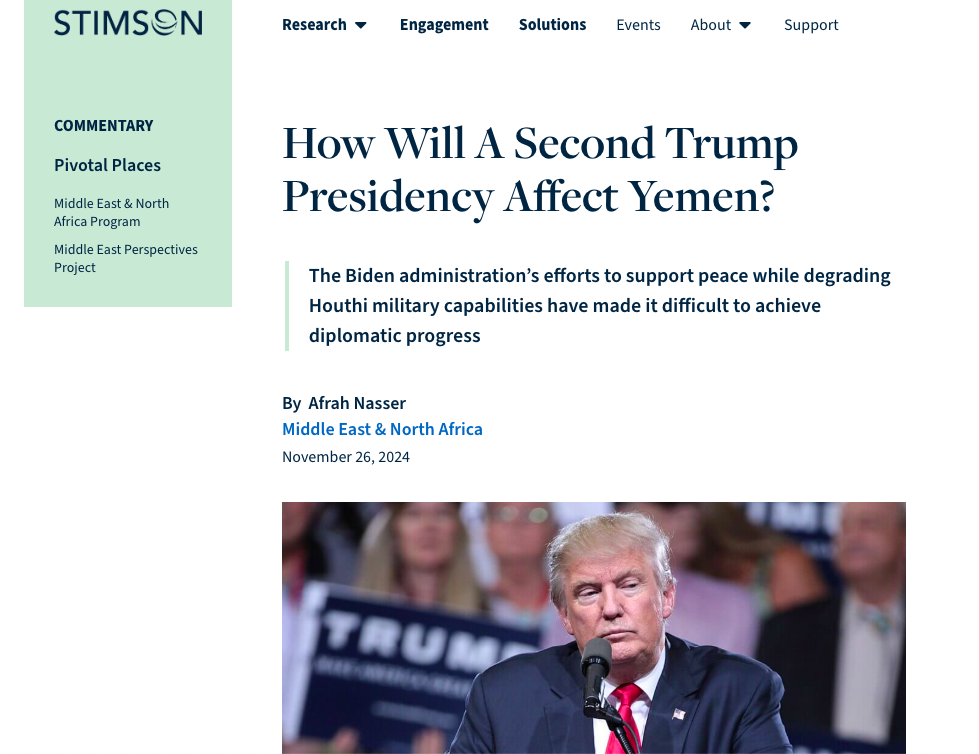
Stimson Center - U.S. presidential elections were closely watched throughout the world, including in Yemen, a nation ravaged by a decade of conflict.
Yemen, the poorest country in the Arab world, is home to one of the Middle East’s most significant non-state actors: the Iran-backed Houthi group, controlling nearly half of Yemen’s population. Over the past year, the Houthis have increasingly disrupted vital global maritime routes, exacerbating tensions in the region.
In a show of solidarity with the Palestinian people, the group has pledged to retaliate against Israel until it ceases its military operations in Gaza, targeting and hijacking vessels the Houthis claim are linked to Israel. This aggressive stance has prompted the United States and the United Kingdom to conduct airstrikes on Houthi military positions inside Yemen. The U.S. has also taken the lead in an international military operation known as Operation Prosperity Guardian, shooting down drones that target ships as well as launching airstrikes to counter Houthi military capabilities. Meanwhile, the Houthis have also launched limited missile strikes on Israeli cities, prompting Israel to retaliate with multiple attacks on Yemen. In this complex theater of geopolitics, U.S. foreign policy decisions will be crucial in shaping Yemen’s future.
Vice President Kamala Harris, the unsuccessful Democratic presidential nominee, had maintained President Joe Biden’s approach to Yemen, which tended to overlook the connection between the Houthis’ attacks and the ongoing war in Gaza. In the past, Harris had aligned with more progressive members of her party by co-sponsoring legislation to end U.S. support for Saudi Arabia’s military operations in Yemen. However, that was before the Houthi threat to international shipping escalated in the Red Sea.
For his part, Trump backed the Saudi-led war on Yemen during his administration and vetoed a bipartisan effort to pull U.S. support for Riyadh. As he was leaving office in January 2021, he went further, designating the Houthis as a foreign terrorist organization. This move was meant to further isolate the Houthis and cut off international humanitarian relief for Yemenis under Houthis control. Under pressure from humanitarian organizations, which warned that it could make the dire situation in Yemen even worse, the designation was lifted by the Biden administration. At the same time, Trump criticized his successor for launching military strikes against the Houthis, claiming that Biden was “dropping bombs all over the Middle East.” This is not to say that Trump would not continue these actions should he return to office or put Houthis back on the terrorism list.
In 2022, with strong backing from the Biden administration, a UN-brokered truce managed to pause the long-running conflict between the Houthis and Saudi Arabia, offering some hope for a peaceful settlement. Though that truce technically expired after being renewed twice, both sides have largely stuck to it, holding off on major offensives and opening the door for a series of quiet talks. The two sides are still struggling to reach agreements over border security and economic matters, among other issues. Following the outbreak of the Gaza war last year, peace efforts have halted due to the escalating Houthi attacks in the Red Sea. Reports in May indicated that the U.S. has given Saudi Arabia an informal go-ahead to revive peace efforts with the Houthis. But the Biden administration’s efforts to support peace while degrading Houthi military capabilities and reducing attacks on Red Sea shipping made it difficult to achieve diplomatic progress.
The second Trump administration will play a critical role in determining the future of Yemen. Decisions made in the coming months will not only impact Yemen’s trajectory but also resonate throughout the broader Middle East.
Yemen plays a significant role due to its strategic location along the Red Sea, a crucial global trade route. Its proximity to U.S. interests raises concerns when the Houthis threaten American assets, including military bases in Djibouti and Eritrea. Recent Houthi attacks have put global supply chains and regional stability at risk. Supported by Iran, the Houthis challenge Yemen’s government and neighboring countries, particularly U.S.-allies Saudi Arabia and the United Arab Emirates. Meanwhile, the Al-Qaeda in the Arabian Peninsula group (AQAP) in Yemen poses a direct threat by planning attacks on military and diplomatic targets, recruiting extremists, and spreading anti-U.S. propaganda that can inspire global terrorism.
U.S. policy on Yemen has been largely reactive. A bolder, more visionary strategy must lean into the art of diplomacy, grappling with the root causes of Yemen’s relentless turmoil as well as regional rivalries and proxy wars.
The next U.S. administration should adopt a multifaceted approach focused on two key areas: First, it is crucial to acknowledge the link between Houthi attacks in the Red Sea and the conflict in Gaza. This recognition should prompt a shift toward facilitating a comprehensive resolution that begins with a ceasefire in Gaza.
Second, the administration must support the establishment of a politically and militarily unified Yemeni government to strengthen the Yemeni state, enabling it to effectively address various threats, including Houthi influence, both domestically and regionally. In tandem, the administration should prioritize and facilitate an inclusive peace process that engages all relevant stakeholders.
---------------------------
This article was first written for and published on the website of Stimson Center.
Thursday, November 21, 2024
Redefining a U.S. Path in Yemen

While the rhetoric was not surprising, it was a reminder of the realities in Yemen that awaited either Kamala Harris or Donald Trump in the White House. With U.S. foreign policy once again at a turning point with Trump's return to power, the prospect for a better U.S. approach to Yemen may be lost. What Yemen really needs is a strategy beyond rival power plays—a call for genuine partnership in the pursuit of peace and stability.
For too long, going back to Barack Obama's presidency and extending through Trump's first term and Joe Biden's administration, the U.S. has seen Yemen almost exclusively through the lens of Saudi Arabia's security interests. This narrow perspective allowed Saudi Arabia to effectively shape Yemen's political trajectory following the Arab Spring in 2011, through the Gulf Cooperation Council's initiative for a flawed political transition after the fall of longtime President Ali Abdullah Saleh. With its Saudi-centric view of Yemen, Washington later empowered the Saudi-led military intervention in Yemen in 2015.
When Houthi attacks on Red Sea shipping erupted last year in response to Israel's punishing war in Gaza, the U.S. took a reactive stance, narrowly targeting Houthi military interests rather than addressing the broader, underlying issues: the need for a cease-fire in Gaza to reduce tensions across the region and a resolution to Yemen's deepening political fragmentation. Washington should not keep sidelining Yemen's unique political and economic realities, but there is little hope that the new Trump administration will change anything.
After years of inconsistent and, at times, contradictory policies—including an ambivalent approach to Yemen's long-stalled peace process and involvement in escalatory military operations under initiatives like Operation Prosperity Guardian, the U.S.-led naval coalition in the Red Sea—the U.S. has deeply compromised its standing in Yemen. Amid U.S. support for Israel's war in Gaza, where American-made weapons contribute to a plausible genocide, Yemenis see little reason to trust U.S. intentions. This perception of U.S. complicity in violence only fuels anti-American sentiment, playing directly into the hands of groups like the Houthis and al-Qaida in Yemen, which leverage this distrust to recruit and spread their own narratives of U.S. aggression. The U.S. would have struggled to regain credibility in Yemen under a Harris administration, and the chances will be even less under Trump.
U.S. policy in Yemen must exist beyond mere military might. Presidents going back to Obama have struggled to balance U.S. interests in Yemen with the need to recognize Yemen's sovereignty and prioritize long-term stability. Washington has been too focused on short-term security goals—again, often shaped by Saudi Arabia's own interests—over a longer view that addresses the root causes of instability and attempts to build a more sustainable partnership with Yemeni parties.
Ongoing Houthi attacks in the Red Sea pose significant risks to U.S. interests, regional stability and the U.S. Navy itself. These attacks threaten maritime security by jeopardizing freedom of navigation through the Bab al-Mandab Strait, a crucial chokepoint for international trade and energy supply routes, and with it U.S. interests in safe shipping lanes. The attacks have led to increased shipping costs and longer transit times, disrupting not only U.S. businesses but global supply chains, with broader economic repercussions around the world. With near-daily Houthi attacks, the U.S. Navy's mission in the Red Sea "has turned into the most intense running sea battle the Navy has faced since World War II," as Naval leaders and experts told the Associated Press. The threat to U.S. forces is particularly intense given the Houthis' growing arsenal of missiles and drones, as evidenced by large-scale engagements like the Houthi attack on the USS Laboon last January. Houthi forces claim that all U.S. bases and naval fleets in the region are now within range of their missiles.
The costs of U.S. military efforts to deter these attacks are adding up. Since October 7, 2023, the U.S. has spent $4.86 billion on military operations in Yemen and the wider region in the Red Sea and Gulf of Aden. And still, Houthi attacks continue; they have not been "deterred," as the U.S. set out to do. Meanwhile, the Houthis' ability to facilitate safe passage for Red Sea shipping aligned with China and Russia, while targeting vessels from U.S.-aligned countries, could shift regional economic alliances by undermining a key pillar of U.S. policy in the Middle East: freedom of navigation through the region's waterways.
The Houthis' attacks against Israel over the war in Gaza have amplified their influence in Yemen and beyond, aligning them with regional anti-U.S. and anti-Israel sentiments. By directly attacking U.S. and British vessels in response to Israel's war, the Houthis have boosted their role within the so-called "resistance" bloc of regional militias backed in varying degrees by Iran, with the Houthis possibly supplanting even Hezbollah. In short, the Houthis have positioned themselves as a central player against U.S.-aligned regional interests.
To address both the Houthi threats and the security of the Red Sea, the U.S. must build credibility in Yemen that isn't simply about rolling back military interventions or distancing itself from conflicts; it's also about understanding and supporting Yemen's internal sociopolitical landscape. A new approach would include investing in localized peacebuilding efforts, supporting Yemeni-led initiatives, and addressing economic issues that fuel support for groups like the Houthis and al-Qaida. The U.S. could regain some trust by respecting Yemen's autonomy and facilitating solutions that recognize Yemen's rich, complex historical context and its capacity for self-determination. To navigate all these issues, Washington would need to engage in Yemen with humility, acknowledging the harm of past policies. Repairing this fractured relationship requires a sincere commitment to fostering peace, not furthering conflict, if the U.S. hopes to regain any semblance of respect or influence in Yemen and the broader region.
If the U.S. wants to show a sincere commitment to fostering peace, it has to apply its policies uniformly across the region. That's why the first step would be to support a long overdue cease-fire in Gaza. The next administration should recognize the limits of American power; whether Trump will is another matter. But it is clear that in Yemen, U.S. airstrikes and naval deployments in the Red Sea to "deter" Houthi attacks have proven ineffective.
It is unlikely that the incoming Trump administration will reckon with these longstanding problems in U.S. policy, given its other priorities, as well as the likelihood that Trump will be even more beholden to Saudi Arabia than any other American president. Yemen, and Yemenis, will suffer. Instead of a more balanced U.S. approach to Yemen that could involve supporting Yemeni-led peacebuilding efforts and addressing economic hardships that fuel Houthi support, we may see even deeper U.S. military entanglement, given Trump's track record during his first term, including vetoing a bipartisan resolution to end U.S. involvement in the Saudi-led war in Yemen.
Under Trump 2.0, there is little chance that the U.S. will seek to restore its credibility in Yemen and prioritize Yemen's own sovereignty over the interests of regional powers like Saudi Arabia and the United Arab Emirates, both of which have appeared to strongly favor Trump over Biden or Harris. To redefine its role in Yemen, the U.S. must redefine its Yemen policy, one that aims for a sustainable path of stability, instead of more military intervention that only feeds further unrest and misery for Yemenis. But any chance of changing U.S. policy will now probably have to wait another four years.
-------------------------------------------
This article was first written for and published on the DAWN website.
Thursday, October 3, 2024
A Decade On, Assessing Shared Responsibility for Yemen’s Tragedy

The Arab Center Washington DC - On September 21, 2014, Yemen’s capital Sanaa awoke to an unexpected turn of events that would reshape the country’s destiny. The Houthi armed group, officially known as Ansar Allah, had seized the city after a prepared march. The takeover had unfolded against the backdrop of popular grievances over the failure of President Abdrabbuh Mansur Hadi’s transitional government to address economic hardship, corruption, and a pervasive sense of marginalization. Seeking to exploit this widespread discontent, the Houthis had forged a strategic alliance with former President Ali Abdullah Saleh, a move that merged their interests with his deep-rooted political influence. Government buildings fell swiftly after the Houthis entered Sanaa as they occupied the parliament, ministries, and military installations, one after another. Media outlets broadcast new messages under Houthi control, signaling a dramatic shift in power.
The rapid takeover sent shockwaves throughout the region. Saudi Arabia watched with mounting concern, seeing the Houthis’ ascendancy as an extension of Iranian influence and a growing threat on its southern border. In March 2015, determined to stop the group, the kingdom—leading a coalition of regional allies backed by the United States and the United Kingdom—launched Operation Decisive Storm. Years of intense conflict ensued, as air raids and ground battles became a grim reality for Yemenis. Despite the coalition’s relentless military campaign, the Houthis gained and held control over significant territory, showcasing resilience and tactical acumen. Currently some 70-80 percent of the population lives under Houthi control.
Today, Yemen finds itself deeply fragmented, embroiled in a protracted conflict marked by fragile truces, escalating tensions, and a worsening humanitarian crisis. What began as an internal power struggle has evolved into a complex web of regional rivalries and proxy wars. Saudi Arabia backed Hadi’s internationally recognized government, while United Arab Emirates (UAE), nominally part of the Saudi-led coalition, began to pursue its own strategic interests by supporting southern secessionists and controlling critical infrastructure. Meanwhile, whispers of Iran’s hand in the conflict grew louder. Tehran’s support of the Houthis—through arms, training, and political backing—served its objective of expanding its regional influence and challenging Saudi dominance. The intricate dance of these competing powers has worsened the conflict and deepened internal divisions, turning Yemen into a battleground for broader geopolitical contests.
With no clear resolution in sight, the prospect of a unified Yemen remains dim. As internal fragmentation and contesting regional ambitions continue, the dream of lasting peace also has slipped further out of reach. The decade-long conflict is a shared tragedy in which all parties—domestic factions and regional powers alike—have prioritized political dominance over peace, perpetuating unending violence that has caused immense humanitarian suffering.
Houthi Strategy and Consequences
Long before the world took notice in 2014, the Houthi group was already deeply entrenched in a cycle of conflict. Between 2004 and 2010, the Houthis engaged in six fierce wars against the Sanaa government in a series of confrontations collectively known as the Saadah Wars. These were not mere skirmishes, but protracted conflicts fueled by a complex web of political disenfranchisement, economic neglect, and religious grievances. These years of relentless warfare honed the Houthis’ military strategies and solidified their organizational structure.
Since 2014, the Houthis have systematically consolidated power through strategic governance and military tactics. The group adopted a more calculated approach of entrenching themselves in state institutions instead of dismantling them. They also established a governance system in which real authority is held by a network of loyalist supervisors behind a façade of technocratic officials. Through this approach, the Houthis were able to centralize control, marginalize traditional actors like tribal leaders, and tighten their grip on power. The group’s alliance with former President Saleh and elements of Yemen’s weakened state apparatus facilitated this consolidation.
The Houthis faced the daunting task, however, of financing a prolonged military campaign. To cover the costs of war and those of governing, they imposed new taxes and levies across the territories under their control, burdening businesses and citizens. Militarily, they capitalized on the power vacuum, gaining territory in northern Yemen while facing resistance in areas like the oil-rich region of Marib. As part of their advance, the Houthis took over the national army’s arsenal, significantly strengthening their military capabilities. But amidst their military advances, a darker aspect of the Houthis’ strategy emerged. The group, like other actors in the Yemeni conflict, has recruited boys as young as twelve and thrust them into the front lines.
The Houthis also have made major changes to the education system. They reformed the school curricula by incorporating their religious and political ideologies into lessons on history, literature, and social studies, influencing the younger generation.
The group is motivated by a profound desire to protect and promote Zaydi Shia traditions, which they believe Yemen’s previous rulers have marginalized. For the Houthis, these traditions represent their religious and political heritage, which they claim has eroded since the fall of the Zaydi Imamate in 1962. In response to Wahhabi influence backed by Saudi Arabia, they view their movement as a defense of their identity, using Zaydi practices to assert leadership and to legitimize their resistance to marginalization. Their refusal to compromise on core ideological principles, especially on the absolute authority of their leader, Abdelmalek al-Houthi, has been a barrier to wider acceptance among the population. This uncompromising stance made it difficult to build bridges with other factions and hindered efforts toward sustainable governance.
A major trigger for the Houthis’ decision to seize the capital a decade ago was their opposition to a 2013 decentralization proposal being discussed by the Gulf Cooperation Council-backed National Dialogue Conference, a reform roadmap developed in the wake of Yemen’s 2011 popular uprising that ousted President Saleh. The Houthis perceived the adoption of a federal system as a direct threat by limiting their influence and access to vital resources. Determined to avoid being sidelined, the Houthis embarked on their campaign to expand their territorial control to Sanaa and beyond, disrupting what was supposed to be a transition from Saleh’s regime to a more inclusive government.
Government Coalition Dynamics
After Sanaa fell and President Hadi and his cabinet fled to Saudi Arabia, the exiled Yemeni government struggled to assert authority from abroad. Stripped of their stronghold in the capital, officials had to operate from the southern city of Aden as well as Riyadh, Saudi Arabia. The distance from Sanaa, where centralized authority had resided, further weakened Hadi’s ability to govern effectively and to provide essential services to a nation already teetering on the brink of collapse.
Internal divisions surfaced as government factions clashed over strategies, and rampant corruption eroded public trust. Meanwhile, the reconstituted national army, which was supposed to be a unified front against the Houthi insurgency, splintered into factions with divided loyalties. This fragmentation left the Yemeni government vulnerable to the relentless advances of the Houthis and other rival factions vying for power.
When the Saudi-led coalition intervened in the conflict, its mission was to strengthen the Yemeni government with military, financial, and logistical support. Yemeni officials initially welcomed the coalition hoping it would restore stability and repel the advancing Houthis. But the situation quickly deteriorated as extensive coalition airstrikes targeted Houthi-held areas, causing significant civilian casualties and severe infrastructure damage. As communities suffered, resentment grew, and the promise of peace faded. Ironically, the coalition’s actions inadvertently strengthened the Houthis by diminishing trust in their adversaries. In April 2022, the Presidential Leadership Council (PLC) was announced from Riyadh, with the backing of Saudi Arabia and the UAE, established to unify anti-Houthi factions. However, internal coalition divisions seeped into the council itself, causing friction among its members, each influenced by their backers’ agendas, and fracturing the anti-Houthi front.
The Role of Regional Actors
The involvement of regional powers—Saudi Arabia, the UAE, and Iran—deepened Yemen’s conflict. Determined to limit the Houthi-Iran threat, Saudi Arabia launched a campaign with hopes of a swift military victory. The conflict, however, dragged on far longer than Riyadh anticipated, eventually forcing Saudi Arabia to recalibrate its strategy. No longer solely focused on defeating the Houthis on the battlefield, Riyadh began to negotiate for a truce with them and to forge new alliances with other factions, help form new specialized forces, and back select PLC members to counterbalance the UAE’s growing influence.
The UAE, initially a key coalition player, pivoted to prioritize strategic interests in southern Yemen, a region rich in resources and dotted with strategic ports. Recognizing the economic and geopolitical value of these areas, the UAE extended its support to the Southern Transitional Council (STC), a group fervently seeking the secession of southern Yemen due to historical grievances and a desire to restore the independence of South Yemen, which existed before the unification in 1990. The STC, empowered by the UAE, swiftly gained control over significant territory and revenue sources, including key ports, such as in Aden and Mayoun, that served as lifelines for international trade and maritime routes. The STC’s rise was meteoric and it established a stronghold that directly challenged the PLC’s authority. The UAE also backed select PLC members.
Thus, supposed coalition partners Saudi Arabia and the UAE backed different factions within Yemen, each pursuing their own interests with little regard for the unified front they once presented. As they created a fragmented military landscape, clashes between their proxy forces became common. Since 2017, UAE-backed forces have been controlling key military positions on Yemen’s Socotra Island in the Arabian Sea, adjacent to Saudi-supported forces. STC-affiliated forces seized the presidential palace in Aden in 2019 and 2023. In 2021, divergent UAE-Saudi approaches contributed to tribal clashes and deepening security troubles in Shabwa governorate.
For their part, the Houthis found a close ally in Iran, which starting in 2014 boosted its military support to the group. Iran provided advanced weaponry, training, and strategic guidance, significantly enhancing the Houthis’ capabilities and resilience. Iran’s backing transformed the Houthis from a regional insurgent group into a formidable force capable of sustaining prolonged military pressure. Despite facing numerous setbacks on the battlefield, the Houthis’ strengthened arsenal and tactical prowess has allowed them to withstand assaults that might have broken a less-equipped group.
Collectively, these regional dynamics have helped shape the war, with each actor pursuing its own agenda—and prolonging conflict and the suffering of the Yemeni people.
The Human Toll
Indeed, the conflict has triggered one of the most devastating humanitarian crises in recent history, with all parties responsible for the collapse of vital services and for widespread human rights abuses. The destruction of infrastructure has crippled access to essential resources, leaving millions without healthcare, clean water, or education. Blockades and supply disruptions have exacerbated food shortages, pushing large segments of the population into acute food insecurity. All warring parties’ recruitment of child soldiers and the enduring violence have inflicted deep psychological trauma, with lasting consequences for Yemeni society. International relief efforts face access restrictions, security risks, and chronic underfunding, significantly hampering the delivery of aid. Warring factions’ manipulation of humanitarian assistance has further undermined the humanitarian response leaving the most vulnerable populations without the support they urgently need.
Policy Recommendations
A path to peace requires more than just ceasefires—it calls for a strategy that addresses both the political and humanitarian dimensions of the crisis. The international community must come together with a unified purpose, pressing Saudi Arabia, the UAE, and Iran to end their support for rival factions. If there is to be any hope of stability, these powers must be urged to step back from their narrow interests. To move forward, the international community must push for a cohesive strategy that refocuses efforts on stabilizing Yemen as a whole, not fragmenting it further.
But unity on the international front is not enough: the Yemeni factions themselves must come to the table. The Houthis, the PLC, the STC, and others need to engage in an inclusive dialogue, one that does not merely shuffle power among leaders but addresses core grievances driving the war. Only by fostering consensus can a viable roadmap for Yemen’s future emerge—one that reflects the aspirations of all its people, not just those in power.
Monday, September 30, 2024
Webinar: How to Improve Access to Climate Information and Curb Misinformation in the MENA Region
I co-participated in a panel discussion organized by Earth Journalism Network, which launched its study on improving access to climate information in the MENA region. You may download the study here.
Monday, September 9, 2024
Can the Houthis' solidarity with Palestine hide their iron-fisted rule in war-torn Yemen?
I spoke with Al Jazeera English's podcast, the Take, on 9 Sept about how the Houthis showed up for Palestine - and failed Yemenis.
Source, AJE's the Take.

Thursday, August 1, 2024
Kill Their Own Blood? Honor Killings, Family, and Human Rights

These acts are common in places with significant gender inequality and are often fueled by misinterpretations of cultural or religious beliefs. If we ask the male family member who committed the act of violence about their motivation, they would say it was necessary to protect the family’s honor. This reflects deep-rooted cultural norms that value the family’s reputation over the individual’s rights.
Kinship Manifested in Violence: A Paradox
What is troubling about honor killings is that blood is both a symbol of kinship and a tool for violence. A paradox indeed! Blood ties are supposed to be the deepest bonds of love and protection, but at the same time, they can be twisted into a rationale for murder under the guise of preserving family honor. It baffles me how the same familial bond that nurtures and sustains life also becomes the justification for taking it away. The only explanation I managed to arrive at is that cultural norms can transform the intimate connection of blood into a means of control and upholding patriarchal values.
Unfortunately, there are numerous cases of honor killings in Middle Eastern communities. Some of these include the murder of Israa Ghrayeb in Palestine in 2019 by her family members for appearing in a social media post with her fiancé, the murder of a daughter by her father in Egypt in 2018 for having an affair, the brutal killing of Dua Khalil Aswad, stoned to death in 2007 by a mob including her relatives in Iraq for having an affair with a Sunni man, and the case of Iraqi-Kurdish Banaz Mahmod in the UK in 2006, killed by her family for leaving an abusive arranged marriage and starting a new relationship.
Legal consequences in these cases have shown inconsistency, revealing difficulties in prosecuting such crimes. In the cases of Israa and Banaz, their family members were convicted. In the case of the Egyptian daughter, her father received a life sentence. However, in Dua’s case, despite the murder being captured on video, only a few perpetrators were brought to justice. These cases show how the intimate bonds of family can be weaponized, leading to devastating consequences for individuals, particularly women and girls. In the absence of strong legal protection, women and girls would continue to be potential victims of those crimes. There should be a mechanism of accountability and justice to end these crimes.
Norms and Misinterpretations
Various societies strongly believe in patriarchal values, stemming from certain cultural norms and misinterpretations of religious texts, which prioritize family honor. These values enforce strict gender roles and control over women’s behavior, often justifying violence for the sake of restoring family reputation. Growing up in Yemen, a Muslim country, I was taught some Quranic verses and Hadith about modesty and family honor. Teachers and religious figures often interpret these teachings in a way that justifies violence against women.
However, mainstream Islamic teachings and scholars emphasize that honor killings are a severe misrepresentation of religious doctrine and are not condoned by Islam. Unfortunately, the prevalence of these misinterpretations leaves little room for understanding otherwise. Thus, honor killings are wrongly seen as acceptable or necessary to maintain social order.
Given these circumstances, women and girls often have no real option other than conforming to traditional norms to maintain social standing. Any resistance to societal pressure, rigid gender roles, and community expectations might lead to violence. Families feel intense pressure to control their daughters, sisters, or any female relatives to uphold perceived honor. Individuals also feel the need to preserve societal reputation over personal liberties, perpetuating honor killings.
Those who commit honor killings are often compelled by societal pressure to conform to traditional expectations and moral considerations, maintaining their family’s honor in the community’s eyes. The lack of widespread condemnation or opposition to honor killings perpetuates the status quo, making it tough to challenge these violent acts.
A Chance to Live Freely
I always thought I was lucky that I grew up with little influence of male members in my family. My parents separated when I was nearly 7 years old. That meant that my father left our home since my childhood. During those 7 years, he was kind to me and my sister but not to my mother and his sisters. Thank God I didn’t have a brother. After separation, my mother and father divorced a few years later. With that, there was no way for my father to control me, my sister, or my mother. The family’s reputation was still significant to my father.
Growing up in this environment, I was able to witness firsthand how the absence of strict patriarchal control can influence a woman’s life. My mother, sister, and I were able to live more freely without the constant fear of bringing shame to our family. This experience starkly contrasts with the harsh realities faced by many women in the Middle East who live under the oppressive weight of family honor.
Understanding my own relative freedom made me acutely aware of the severe restrictions placed on women in similar cultures, where any deviation from prescribed behavior can result in tragic consequences like honor killings. The way my life turned out has only deepened my empathy for the victims of honor-based violence and strengthened my resolve to advocate for change.
A Much-Warranted Change
The heartbreaking stories of Israa, Dua, Banaz, and others reveal how deeply ingrained cultural norms can twist familial love into a tool for control and violence. These cases underscore the urgent need for societal change and strong legal protections for women.
Given the scale of the issue, tackling honor killings requires a comprehensive approach. This strategy should operate on three levels: legal, social, and educational. Human rights groups stress that legal accountability and public awareness are key to ending honor killings. It’s not enough to just have laws on paper; governments must enforce strict penalties for those who commit these crimes and ensure cultural justifications are not accepted as excuses. Human Rights Watch points out that stronger legal frameworks and consistent enforcement can significantly reduce these incidents.
Laws protecting women’s rights are essential for deterring potential offenders and providing justice for victims. However, legal measures alone aren’t sufficient. Ongoing social efforts are also necessary. A holistic approach that combines legal action with education, public discussions, and support systems for women is crucial for making lasting changes.
Implementing educational programs that promote gender equality and challenge patriarchal norms is vital for shifting public perception. Advocacy groups play a crucial role in raising awareness and supporting victims. Collaborative efforts between NGOs, community leaders, and government bodies can drive cultural change and support victim rehabilitation.
The Outlook
Changing deeply ingrained beliefs that devalue women is no easy task. Honor killings, rooted in cultural traditions and misinterpretations of religious teachings, show the struggle between maintaining societal norms and protecting human rights. This tension presents a significant challenge for Arab communities and governments, as inconsistent legal responses highlight the difficulties in prosecuting these crimes effectively.
Human rights groups, such as Kafa in Lebanon, Nazra for Feminist Studies in Egypt, and others, are working tirelessly to pressure governments to reform laws and practices that enable honor killings. They push for stronger legal frameworks that align with global human rights standards. Implementing these reforms is crucial for safeguarding women’s rights and improving a country’s international reputation.
Efforts to eradicate honor killings are closely tied to broader movements for gender equality. Educational programs and community advocacy are vital in challenging patriarchal norms and changing public perceptions. These initiatives can gradually transform societal attitudes towards women’s rights, reducing the acceptance of such violence.
The prevalence and acceptance of honor killings vary across the Arab world, influenced by local cultural, religious, and legal factors. While some countries have made notable strides in legal reform and education, others continue to struggle with deeply entrenched norms resistant to change. This variation calls for tailored approaches that respect local contexts while aiming for universal human rights standards.
Given the complexity of honor killings in Arab culture, the solution would be complex as well. We must navigate a complex web of cultural, legal, and social factors. But remember, every step we take toward change and reform is a step toward saving lives. It’s a daunting journey, but one that we must undertake with courage, empathy, and unwavering commitment to justice.
Thursday, May 23, 2024
The Human Cost of Yemen's Health Care Collapse

Last August, my world turned upside down when my mother was diagnosed with cancer. At the time, I was working with a Yemeni colleague on an investigative piece about rising cancer cases in Yemen tied to pollutants from the oil industry. The irony was not lost on me, as media reports had been chronicling how fuel companies in Yemen flagrantly violated environmental protections. Overwhelmed by the news, my ability to write was paralyzed for months. It plunged me into an exhausting and emotionally draining ordeal that was both a medical marathon and a financial whirlwind.
Ten months later, today, I can write not only to recount my mother's courageous battle and eventual triumph over cancer, but to address a broader crisis. This journey through sickness and recovery has reshaped me, leaving indelible scars. I know now, more than ever, the staggering human costs of the collapse of Yemen's health care system.
Years of conflict in Yemen, fueled by both internal and external forces, from the Houthi takeover of Sanaa in September 2014 to the Saudi-led military intervention in 2015, have ravaged nearly every facet of life for the Yemeni people. The most recent data, already outdated from 2021, comes from the United Nations Development Program, which estimated nearly 377,000 deaths due to war's impact—a figure many experts consider conservative. The actual death toll could be significantly higher. For those who perished, death may have been a release. The survivors face dire circumstances, grappling with a destroyed health care system by all parties to the conflict. Currently, out of Yemen's 35 million people, approximately 20 million people urgently require medical assistance. As of February 2023, the World Health Organization reported that 46 percent of Yemen's health facilities were either partially operational or completely nonfunctional, crippled by shortages of staff, funding, electricity, medicine and other basic supplies and equipment. Working in health care in Yemen is dangerous, even deadly. In 2022, at least seven heath workers were killed in attacks on hospitals and other health care facilities, and five others were abducted.
For ordinary Yemenis, the shattered health care system means an almost certain death sentence when faced with serious illness, spanning all socioeconomic classes. Cancer cases are rampant, but cancer care in particular is prohibitively expensive and scarce. Many cancer clinics have been forced to close because of the war, so patients can only find cancer treatment at a few hospitals in cities like Sanaa, Taiz, Aden, Ibb and Hadramout. Yet even these facilities often lack adequate medical resources. Some patients can't even afford the transportation expense to and from the few cancer treatment centers.
On the other hand, for some fortunate Yemenis, the only recourse is seeking medical treatment abroad, usually in Egypt or Jordan, which involves either borrowing substantial sums of money or spending their life savings. The scenes at airports, from Sanaa to Cairo and Amman, are heart-wrenching testimonies to the state's collapse, as desperate Yemenis—children, men and women alike—gather to seek medical care abroad. When I was in Jordan for my mother's medical treatment, I was told by Jordanian friends that during the COVID-19 lockdown, the drop in Yemenis seeking vital medical care in Jordan strained the Jordanian health care sector. For years now, Yemenis have made up a sizable portion of patients in Egyptian and Jordanian hospitals.
The logistical challenges compound the financial ones. Obtaining visas for both patients and their caregivers is fraught with difficulties, and the costs of treatment and living abroad add another layer of hardship. Cancer treatment is a prolonged journey, with both physical and financial strain.
According to an official from Yemen's Ministry of Health, who spoke to me on the condition of anonymity, the number of cancer patients ranges from 25,000 to 30,000 annually. Tragically, nearly 60 percent of these patients die due to a lack of resources, medical tools and services, and the scarcity of medicines at cancer treatment centers. In some cases, some families just take their loved ones home and wait agonizingly for death.
This health crisis has not only been caused by war alone, but can be traced to three major environmental catastrophes that are widely suspected of driving the stark rise in cancer cases: crumbling sewage networks, environmental violations by oil and gas companies, and the rampant use of deadly pesticides.
First, due to widespread neglect by state agencies, Yemen's sewage systems have failed in numerous regions of the country, leading to the contamination of drinking water. This breakdown not only increases cancer risks through exposure to carcinogenic chemicals and heavy metals in water and soil, but also spreads pathogens and disrupts ecosystems. Such conditions may indirectly heighten cancer risks via chronic inflammation and continued exposure to environmental toxins.
Second, the oil industry in Yemen, which has operated without enough regulatory oversight both before the war and throughout the conflict, frequently engages in environmentally destructive practices. Local leaders and former officials have reported that oil pollution has diminished agricultural yields and escalated disease rates, including cancer and kidney disorders, within their communities.
Finally, the unregulated use of internationally prohibited and deadly pesticides has become alarmingly prevalent. In 2023, regions under Houthi control imported about 14.5 million liters of pesticides—an enormous surge from prior years. Beyond the officially imported quantities, the influx of smuggled and banned pesticides exacerbates the health and environmental crisis, posing additional cancer risks to Yemenis.
All parties to Yemen's long and brutal conflict, including the Houthis, Saudi Arabia and the United Arab Emirates, are to blame for the suffering of cancer patients in Yemen caused by the devastation of the country's health care system. They all must take responsibility for its reconstruction, echoing calls from the United Nations Panel of Experts on Yemen. Moreover, the current precarious state of Yemen, stuck in a limbo of no war, but no peace, must end. It's time, finally, for a transition to a lasting peace agreement that includes ways of rebuilding and strengthening Yemen's health care system. Medical services cannot recover while medical workers face threats to their lives.
Beyond the war itself, Yemeni authorities must finally exert tighter control on the import and use of pesticides and the country's oil industry, given their suspected connections to the sharp rise in cancer cases. A larger environmental crisis looms. As Helen Lackner and Abulrahman Al-Eryani wrote in 2020, "The current civil war in Yemen threatens the country as a state, but the lesser-known environmental crisis threatens the very existence of Yemen as a habitable land."
This September marks a decade since the Houthi takeover of Sanaa and the ensuing war by the Saudi-led coalition. Reflecting on the past ten years of destruction and suffering in Yemen, it is hard to fathom the depth of the tragedy. People often ask me, "Where did you disappear, Afrah?" Like so many Yemenis, considering everything that has happened, I have been trying to make sense of what has become of my country.
Ten months later, today, I can write not only to recount my mother's courageous battle and eventual triumph over cancer, but to address a broader crisis. This journey through sickness and recovery has reshaped me, leaving indelible scars. I know now, more than ever, the staggering human costs of the collapse of Yemen's health care system.
Years of conflict in Yemen, fueled by both internal and external forces, from the Houthi takeover of Sanaa in September 2014 to the Saudi-led military intervention in 2015, have ravaged nearly every facet of life for the Yemeni people. The most recent data, already outdated from 2021, comes from the United Nations Development Program, which estimated nearly 377,000 deaths due to war's impact—a figure many experts consider conservative. The actual death toll could be significantly higher. For those who perished, death may have been a release. The survivors face dire circumstances, grappling with a destroyed health care system by all parties to the conflict. Currently, out of Yemen's 35 million people, approximately 20 million people urgently require medical assistance. As of February 2023, the World Health Organization reported that 46 percent of Yemen's health facilities were either partially operational or completely nonfunctional, crippled by shortages of staff, funding, electricity, medicine and other basic supplies and equipment. Working in health care in Yemen is dangerous, even deadly. In 2022, at least seven heath workers were killed in attacks on hospitals and other health care facilities, and five others were abducted.
For ordinary Yemenis, the shattered health care system means an almost certain death sentence when faced with serious illness, spanning all socioeconomic classes. Cancer cases are rampant, but cancer care in particular is prohibitively expensive and scarce. Many cancer clinics have been forced to close because of the war, so patients can only find cancer treatment at a few hospitals in cities like Sanaa, Taiz, Aden, Ibb and Hadramout. Yet even these facilities often lack adequate medical resources. Some patients can't even afford the transportation expense to and from the few cancer treatment centers.
On the other hand, for some fortunate Yemenis, the only recourse is seeking medical treatment abroad, usually in Egypt or Jordan, which involves either borrowing substantial sums of money or spending their life savings. The scenes at airports, from Sanaa to Cairo and Amman, are heart-wrenching testimonies to the state's collapse, as desperate Yemenis—children, men and women alike—gather to seek medical care abroad. When I was in Jordan for my mother's medical treatment, I was told by Jordanian friends that during the COVID-19 lockdown, the drop in Yemenis seeking vital medical care in Jordan strained the Jordanian health care sector. For years now, Yemenis have made up a sizable portion of patients in Egyptian and Jordanian hospitals.
The logistical challenges compound the financial ones. Obtaining visas for both patients and their caregivers is fraught with difficulties, and the costs of treatment and living abroad add another layer of hardship. Cancer treatment is a prolonged journey, with both physical and financial strain.
According to an official from Yemen's Ministry of Health, who spoke to me on the condition of anonymity, the number of cancer patients ranges from 25,000 to 30,000 annually. Tragically, nearly 60 percent of these patients die due to a lack of resources, medical tools and services, and the scarcity of medicines at cancer treatment centers. In some cases, some families just take their loved ones home and wait agonizingly for death.
This health crisis has not only been caused by war alone, but can be traced to three major environmental catastrophes that are widely suspected of driving the stark rise in cancer cases: crumbling sewage networks, environmental violations by oil and gas companies, and the rampant use of deadly pesticides.
First, due to widespread neglect by state agencies, Yemen's sewage systems have failed in numerous regions of the country, leading to the contamination of drinking water. This breakdown not only increases cancer risks through exposure to carcinogenic chemicals and heavy metals in water and soil, but also spreads pathogens and disrupts ecosystems. Such conditions may indirectly heighten cancer risks via chronic inflammation and continued exposure to environmental toxins.
Second, the oil industry in Yemen, which has operated without enough regulatory oversight both before the war and throughout the conflict, frequently engages in environmentally destructive practices. Local leaders and former officials have reported that oil pollution has diminished agricultural yields and escalated disease rates, including cancer and kidney disorders, within their communities.
Finally, the unregulated use of internationally prohibited and deadly pesticides has become alarmingly prevalent. In 2023, regions under Houthi control imported about 14.5 million liters of pesticides—an enormous surge from prior years. Beyond the officially imported quantities, the influx of smuggled and banned pesticides exacerbates the health and environmental crisis, posing additional cancer risks to Yemenis.
All parties to Yemen's long and brutal conflict, including the Houthis, Saudi Arabia and the United Arab Emirates, are to blame for the suffering of cancer patients in Yemen caused by the devastation of the country's health care system. They all must take responsibility for its reconstruction, echoing calls from the United Nations Panel of Experts on Yemen. Moreover, the current precarious state of Yemen, stuck in a limbo of no war, but no peace, must end. It's time, finally, for a transition to a lasting peace agreement that includes ways of rebuilding and strengthening Yemen's health care system. Medical services cannot recover while medical workers face threats to their lives.
Beyond the war itself, Yemeni authorities must finally exert tighter control on the import and use of pesticides and the country's oil industry, given their suspected connections to the sharp rise in cancer cases. A larger environmental crisis looms. As Helen Lackner and Abulrahman Al-Eryani wrote in 2020, "The current civil war in Yemen threatens the country as a state, but the lesser-known environmental crisis threatens the very existence of Yemen as a habitable land."
This September marks a decade since the Houthi takeover of Sanaa and the ensuing war by the Saudi-led coalition. Reflecting on the past ten years of destruction and suffering in Yemen, it is hard to fathom the depth of the tragedy. People often ask me, "Where did you disappear, Afrah?" Like so many Yemenis, considering everything that has happened, I have been trying to make sense of what has become of my country.
___________________________________________________
*This article was first written for and published on DAWN's website.
Friday, May 17, 2024
Divergent Saudi-Emirati Agendas Cripple Yemen’s Presidential Leadership Council

The Arab Center Washington DC - Two years into its existence, Yemen’s Presidential Leadership Council (PLC) still has not effectively addressed critical problems facing the country: a dire economic situation, an enduring Houthi threat, and escalating military tensions in the Red Sea. In particular, the PLC’s obvious inability to prevent the Houthis from attacking maritime traffic in the Red Sea signifies its profound ineffectiveness, raising concerns about whether it can fulfill its mandate of governing the Yemeni polity. The fundamental reason for the PLC’s dysfunction, however, rests today in the divergent approaches and lack of harmony between its main backers, the Kingdom of Saudi Arabia (KSA) and the United Arab Emirates (UAE), which hinder unified leadership and decision-making within the council and perpetuate its state of paralysis.
Divergent Saudi and Emirati Approaches
The PLC was established in April 2022 with a dual mandate: to lead the internationally recognized government of Yemen and to unify anti-Houthi factions against their common adversary. The eight-member council is chaired by former interior minister and deputy prime minister Rashad al-Alimi. The UAE and KSA are the PLC’s main backers, but their different agendas and approaches constrain the council’s operations.
First, the two countries support different members within the PLC and do not treat it as a unified entity. The UAE provides support to four members on the council: Aidarous al-Zubaidi, Tareq Saleh, Faraj al-Bahsani, and Abdulrahman al-Mahrami. Al-Zubaidi heads the Southern Transitional Council (STC), a secessionist body calling for the reestablishment of the erstwhile state of South Yemen (formerly named the People’s Democratic Republic of Yemen). The STC’s membership in the PLC is troubling and directly contradicts the council’s primary mandate to unify and strengthen the state. The UAE also provides military support to Saleh, a nephew of former president Ali Abdullah Saleh; to al-Bahsani, former governor of Hadramawt; and to al-Mahrami, a commander of the Southern Giants Brigade forces. For its part, Saudi Arabia supports Sultan Ali al-Arada, Governor of Marib and member of the Saudi-backed Islah Party, and Abdullah al-Alimi, who was the director of former President Abdrabbuh Mansur Hadi’s office and belongs to the Islah Party.
Second, Riyadh and Abu Dhabi avoided setting a clear mandate for the PLC president’s powers and privileges. This allowed each member to remain basically free to have his own agenda and preserve his independence. This has led to a paralyzed leadership and in fact further fragmented state institutions. The entrenched rivalry between PLC factions makes it nearly impossible to forge a clear vision for Yemen’s future or to implement coordinated strategies.
Third, the PLC lacks a unified military force. Each member of the council effectively controls his own military unit, and some units have more power than the council president. For example, al-Zubaidi, the most powerful member, commands stronger forces than even the PLC president. STC-affiliated forces have seized the presidential palace in Aden multiple times. Efforts to merge these forces under the ministries of defense and interior have failed.
The fragmentation within the PLC and Saudi Arabia and the UAE’s divergent agendas are also evident in other areas. Riyadh supported the formation of the Hadramawt National Council, ostensibly as a competitor to the STC. It also helped PLC President Alimi in establishing the Nation’s Shield Force as a unified military formation encompassing many units loyal to the PLC that would counter the UAE-backed STC and its Security Belt forces. Only time will tell, but the proliferation of political formations could encourage conflicting loyalties and rivalries that in turn could fuel the very military fragmentation that the PLC is trying to arrest.
Amid the growing rivalry between Saudi Arabia and the UAE, media reports show that tensions between Saudi- and UAE-backed forces have escalated in parts of the east and south of the country, leading to near-armed confrontations between opposing forces. Such incidents include UAE-backed forces taking control of key military positions in Socotra—a small archipelago of Yemeni islands in the Arabian Sea—adjacent to Saudi-supported forces. Additionally, the STC’s sharing of revenue sources, such as customs and taxes with the government in Aden, has raised concerns about who is in control of the country’s finances. The divergent UAE-Saudi approaches also contributed to deepening security troubles and tribal clashes in provinces such as Shabwa. The UAE-backed STC has intensified its efforts to dislodge forces loyal to the PLC.
The PLC’s Ineffectiveness in Addressing the Red Sea Crisis
The US-led Operation Prosperity Guardian airstrikes on Houthi targets in Yemen also highlighted the PLC’s inability to assert sovereignty. In 2015, the Saudi-led coalition launched its military campaign against the Houthis after President Hadi appealed for support, coordinating efforts with the national army. But during Operation Prosperity Guardian, the United States conducted airstrikes independently, without PLC coordination or approval, demonstrating the PLC’s lack of control over Yemeni territory and diminished global influence.
In response to these challenges, instead of capitalizing on the international focus on Houthi strongholds to strengthen its position, the fractured leadership within the PLC undermined its ability to forge a unified strategy. Council members pursued disparate strategies, each seeking separate military support from the United States and the United Kingdom, which only served to emphasize the lack of a cohesive strategy and further fragmented the council’s response. Vice-chair of the PLC and STC President Al-Zubaidi and PLC member Tareq Saleh, each called for Western help in building up their naval forces to defeat the Houthis. This disunity has not only prevented the PLC from exploiting potential strategic openings but also has significantly weakened its ability to present a united front in the Red Sea conflict, which has exacerbated the crisis.
The Houthis’ continued ability to challenge international interests, combined with the PLC’s failure to assert authority over sea and air, demonstrates a profound governance and leadership failure. The PLC’s ongoing ineffectiveness in addressing external threats and coordinating with major international actors continues to erode its credibility and operational capacity.
The US Position on the PLC’s Divergent Agendas
The United States has not publicly criticized Saudi Arabia and the UAE for supporting competing military and political factions operating outside the control of Yemen’s internationally recognized government. The United States views the PLC as one of many factions that is ineffective in addressing crises. This perception of ineffectiveness also dates back to Yemen’s previous governments. Since 2015, Washington has not condemned the Saudi-led coalition for insufficiently supporting the Yemeni Army in its war against the Houthis. Similarly, the United States took no action when the UAE killed 30 Yemeni soldiers in airstrikes during infighting between government forces and the UAE-backed Southern Transitional Council in Aden. Hadi had previously accused the UAE of behaving like an occupier in the country, rather than as a liberator.
As the PLC weakens and the Houthis grow stronger, the United States now recognizes the need for a more effective council to protect its regional interests, particularly regarding military bases and personnel in neighboring countries. So the US government began making a shift in its strategic priorities in Yemen. It began to take a firmer stance against the Houthis, reclassifying them as a Specially Designated Global Terrorist (SDGT) and linking a peace deal in Yemen with the group ending its Red Sea attacks. Both Riyadh and Abu Dhabi declined to participate in Operation Prosperity Guardian due to concerns about retaliatory Houthi attacks like those on Saudi Arabia and the UAE in 2022. Despite the lack of Gulf allies’ involvement (save Bahrain), Operation Prosperity Guardian demonstrates Washington’s willingness to lead independently. Although the United States now takes a firm stance against the Houthis, it continues to overlook the driving factors empowering them: the divergent approaches of Saudi Arabia and the UAE and the inherent flaws in the PLC.
The United States Can Play a Constructive Role
A first step that the United States can take to help end the Houthi threat in the Red Sea is to prioritize diplomatic efforts to end Israel’s war on Gaza. Washington should also promote stability in Yemen pressuring its Saudi and Emirati allies to harmonize their strategies within the country. Effective US mediation is crucial considering Washington’s strategic relationship with both Gulf countries and the United States’ ability to foster cooperation between them. While the two countries are intimately involved in many aspects of Yemeni affairs, coordinating their approaches can help forge a unified political and military structure under the PLC.
Given the UAE’s resistance to making compromises in its Yemen policy, compared to Saudi Arabia’s willingness to negotiate, US efforts should focus on mitigating the UAE’s obstructive role. This can be achieved by supporting the PLC in enhancing its authority and effectiveness through technical assistance, capacity-building, and diplomatic efforts aimed at unifying its decision-making processes.
Finally, it is important to emphasize that helping the PLC and strengthening its position vis-à-vis other actors in Yemen must be accompanied by efforts to preserve the council’s autonomy. Yemenis have long suffered from external interference in their affairs, mostly at their own expense. Therefore, any interference or strategy must carefully balance the benefits of external support with the preservation of Yemeni sovereignty and self-determination.
___________________________________________________
*This policy analysis paper was written for & published first on the Arab Center Washington DC website.
Subscribe to:
Posts (Atom)